How do I fulfill orders from Facebook ads in Nigeria without losing money on failed deliveries and cash-flow delays? That question sits behind nearly every social commerce seller’s frustration. The ad converts. A lead fills in their details, clicks submit, and waits. On your end, the message lands in your DMs, or maybe a random WhatsApp from a number you do not recognise, or buried inside a comment thread you almost missed. From that moment, the order is in chaos. No confirmation system, no organised dispatch, no reliable way to collect payment. The result is wasted ad spend, stock going out without tracking, and COD rejection rates eating into whatever margin the ad budget left behind.
This guide walks through the complete order fulfilment workflow for Facebook ads sellers in Nigeria, from the moment a lead submits their details to the point the product is in their hands and payment is in your account. If you have been wondering how to fulfil orders from Facebook ads in Nigeria, every step here is actionable and specific to the Nigerian market. Platforms like Selligate E-commerce Fulfillments were built specifically for this workflow, giving social commerce sellers the infrastructure to fulfil same-day and receive payment without chasing dispatch riders or reconciling cash manually. Whether you are starting from scratch or cleaning up a messy process, this guide has you covered.
Step 1: Set up your order intake before the first lead arrives
Most Facebook sellers start running ads before they have a working intake system. Orders come in through DMs, comments, and WhatsApp messages with no structure, and that is exactly where fulfilment breaks down first. Fix the intake system before you launch, not after the first fifty leads arrive in disarray.
Build a lead form or landing page that captures what matters
Your intake form needs to collect full name, phone number, delivery address (including state and city), product choice, and quantity. Capturing these fields upfront eliminates the back-and-forth that delays order processing by hours. For sellers without a developer, Google Forms, Typeform, or a basic Shopify or WooCommerce checkout are practical options that require no technical setup. Facebook Lead Ads are worth prioritising here: the form submits without leaving the app, which reduces drop-off significantly compared to sending customers to an external page.
Automate the lead-to-order flow with simple tools
Once a lead submits, that data should land somewhere structured automatically. Tools like Make.com (formerly Integromat), Zapier, or Pabbly Connect connect your Facebook Lead Ad form directly to a Google Sheet, WhatsApp notification, or CRM in real time. No manual CSV downloads, no missed orders because you were offline. Set up the automation before you launch the ad, not after the chaos has already started.
Step 2: Confirm the order and verify the customer before dispatch
An unconfirmed order is not an order. It is a delivery risk. With COD rejection rates in Nigerian e-commerce sitting between 15% and 30%, dispatching without confirmation is one of the fastest ways to burn through logistics costs.
The confirmation call: what to say and when to make it
Call the customer within 15 to 30 minutes of form submission. This single step disrupts fake orders and impulse submissions before they become failed deliveries. On the call, confirm the product name, delivery address, and expected delivery window. Press for explicit commitment: if the customer sounds non-committal, ask directly whether they will be ready to pay on delivery. A missed call should trigger an SMS or WhatsApp follow-up immediately. Dispatch only after you have verbal confirmation.
Fraud checks that are practical for Nigerian social commerce sellers
Layer your verification rather than relying on a single check. OTP verification at checkout adds a first filter. Address verification tools can also help confirm delivery details before dispatch, for Nigeria-specific options see this Nigeria address verification resource. Flag first-time orders where the delivery address is inconsistent with prior order history or seems implausible given the rest of the customer’s details. For high-value items, require a delivery PIN that only the genuine recipient will know. These checks do not slow down genuine buyers; they filter out the fraudulent ones before the rider ever leaves the warehouse.
Step 3: Position your stock for fast, reliable dispatch
The single biggest reason Facebook ad sellers fail at fulfilment is stock location. Their inventory is in one place while their customers are spread across Lagos, Abuja, Port Harcourt, and beyond. Shipping from a single location adds 24 to 72 hours to every order and increases the chance of rejection because the customer has lost interest by the time the item arrives.
Why pre-positioned inventory is the foundation of same-day delivery
Distributed warehousing means your stock is stored at multiple locations across Nigeria so that when an order comes in, dispatch happens from the nearest point. An order from Ikeja fulfilled from a Lagos distribution point can be delivered within hours. The same order shipped from a single central warehouse could take 48 hours or more. The delivery window is not just a convenience factor; it is directly linked to your rejection rate. Customers who receive same-day delivery are far less likely to change their minds at the door.
How fulfilment warehousing works for Facebook ad orders in Nigeria (and where Selligate comes in)
This is where Selligate E-commerce Fulfillments solves the problem that no standard courier can. The onboarding process is straightforward:
- Register as a merchant on the platform
- Add your products to the catalogue
- Select distribution locations from Selligate’s 40+ nationwide network
- Ship your stock in bulk to those locations
- Assign orders through the app as they come in
The network covers major commercial hubs including Lagos, Abuja, Port Harcourt, Kano, and Ibadan. For a seller fulfilling orders from Facebook ads in Nigeria, this infrastructure is what makes same-day COD delivery possible without managing multiple storage points yourself.
Step 4: Pack and label every order to prevent delivery disputes
A damaged or mislabelled package is a rejection that was entirely preventable. Most small sellers skip this step until they have their first costly dispute, but getting it right from the start costs almost nothing extra and protects your margin.
A practical packing checklist for Nigerian sellers
Use corrugated boxes or padded mailer bags appropriate to the product weight. Wrap fragile items in bubble wrap and seal with tamper-evident tape. Include a packing slip inside the package with the order details. Before handover to the courier, photograph the open package and the sealed package. That photo record is your protection if a customer claims the wrong item was delivered or that the item arrived damaged.
Labelling standards that couriers and fulfilment partners respect
Each package should carry the customer’s full name, phone number, complete delivery address including state, and your return address. Print labels where possible, tools like Canva work well, and label printers available at business centres in Lagos cost as little as NGN 50 per unit. Handwritten addresses are one of the most common causes of failed deliveries in Nigeria, particularly for inter-state shipments where riders are unfamiliar with the area.
Step 5: Choose the right logistics option for your Facebook ad COD orders
Not all logistics options are built the same. The gap between a standard courier and a dedicated fulfilment platform matters a great deal when you are running paid ads and need fast, reliable delivery to protect your return on ad spend.
Courier services in Nigeria and what they actually offer
GIG Logistics (GIGL), Red Star Express, Sendbox, and Peng Logistics are among the most widely used options for e-commerce deliveries in Nigeria. Delivery times range from same-day within Lagos to 48 to 72 hours for inter-state orders, with base rates starting from around NGN 2,000 within Lagos and scaling to between NGN 7,000 and NGN 9,000 for deliveries to Kano or Port Harcourt. Standard couriers move the parcel. They do not manage your inventory, handle returns, or remit COD payments automatically. Reconciling cash collected by multiple riders across multiple cities remains a separate, manual problem you will have to solve on your own.
When a dedicated fulfilment platform is the smarter choice for payment collection on Facebook sales
For a seller fulfilling 20 to 100+ orders per week from Facebook ads, a dedicated fulfilment platform changes the economics entirely. Selligate E-commerce Fulfillments does not just deliver: it stores your inventory at distributed locations, assigns orders through a merchant app, collects COD payment at the door, and automatically credits your in-app wallet once payment is received. No chasing riders for cash, no manual reconciliation at the end of the week, and no delays in knowing what you have actually earned from your campaign. For more background on delivery options across Nigeria, this comprehensive guide to delivery service in Nigeria is a useful reference when comparing providers.
Step 6: Collect payment, track orders, and handle returns cleanly
Getting the product to the customer is only part of the job. Collecting payment reliably and maintaining clear records is what turns fulfilment into a financially sustainable operation rather than a logistics exercise that leaves you guessing at your margins.
How COD payment collection and remittance works in practice
With standard couriers, cash is collected by the rider and transferred to the seller after manual reconciliation. That process typically takes between seven and fifteen working days. For sellers running Facebook ads and reinvesting in the next campaign, that delay kills cash flow. Selligate’s model works differently: once the customer’s order is delivered and payment is received, the merchant’s in-app wallet is credited automatically. Merchants can withdraw to their bank account instantly. For high-volume social commerce sellers, that remittance speed is not a convenience; it is what makes the business viable. For a deeper explanation of how cash-on-delivery revenue and remittance affect your margins, see this primer on revenue from cash on delivery.
Tracking orders, managing rejections, and keeping clean records
Real-time order tracking means you can see delivered, pending, and cancelled orders at a glance without calling riders or waiting for end-of-day reports. When a rejection happens, a proper fulfilment partner handles the return and replacement process for you, removing that burden from your operations entirely. Keeping a full sales and withdrawal history inside one platform also gives you the data you need for business decisions: which products have the highest rejection rates, which locations perform best, and what your actual margins look like after delivery costs.
How to fulfil orders from Facebook ads in Nigeria, build the workflow once, run it at scale
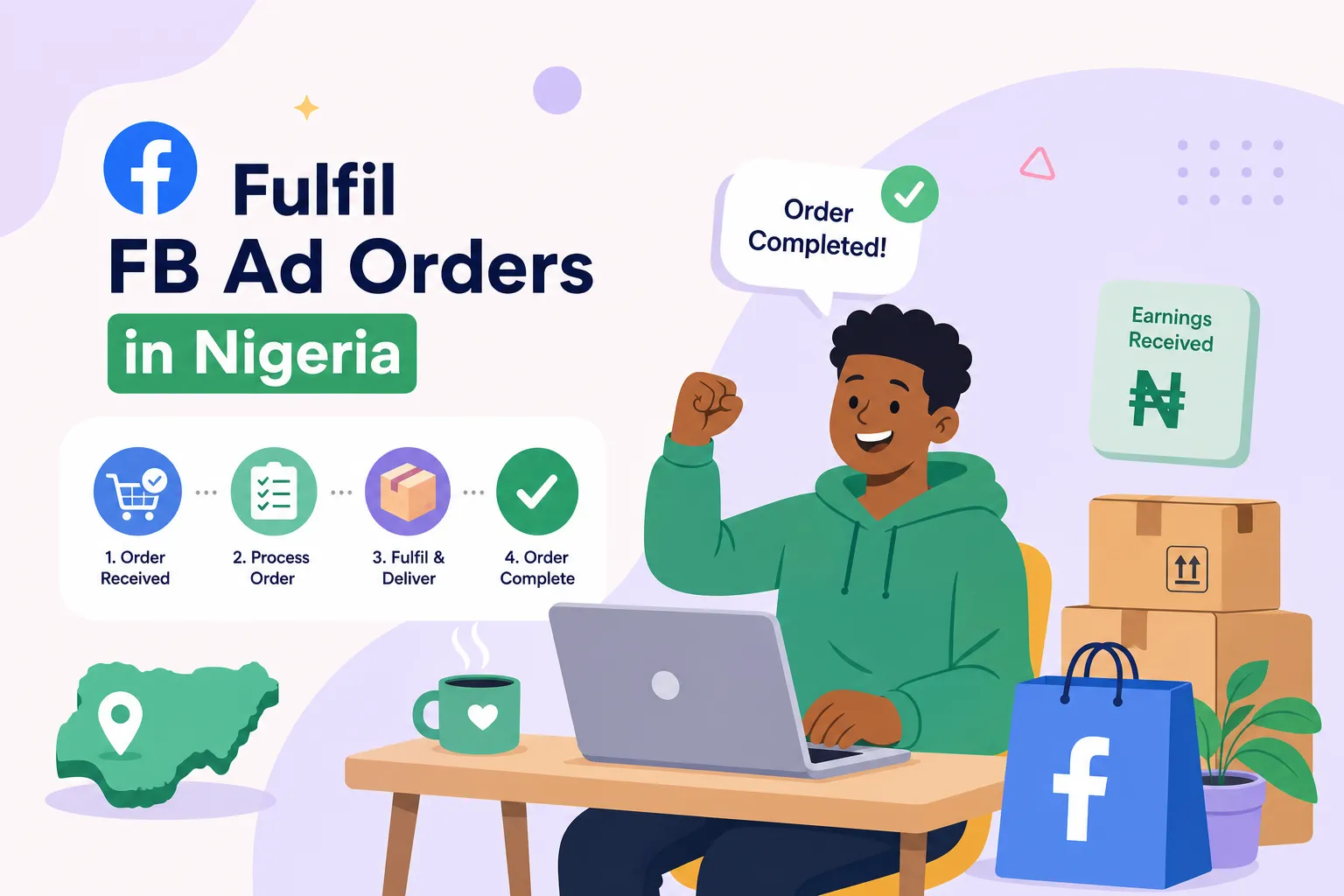
The six steps here form a complete, end-to-end answer to the question of how to fulfil orders from Facebook ads in Nigeria: capture the order cleanly, confirm it immediately, position stock close to the customer, pack and label properly, choose the right delivery and courier option in Nigeria, and collect payment with clear records. The sellers who process Facebook ad sales in Nigeria successfully are not necessarily the ones with the biggest ad budgets. They are the ones who have built a repeatable, reliable process behind the ads.
Selligate E-commerce Fulfillments gives social commerce sellers the infrastructure that was previously only available to large e-commerce businesses: distributed warehousing, same-day delivery, instant payment remittance, and return management, all managed through one app. If your current fulfillment process depends on dispatch riders, manual bank transfer confirmations, and WhatsApp chaos, this workflow replaces it. Register as a merchant on Selligate to put this process into practice immediately.