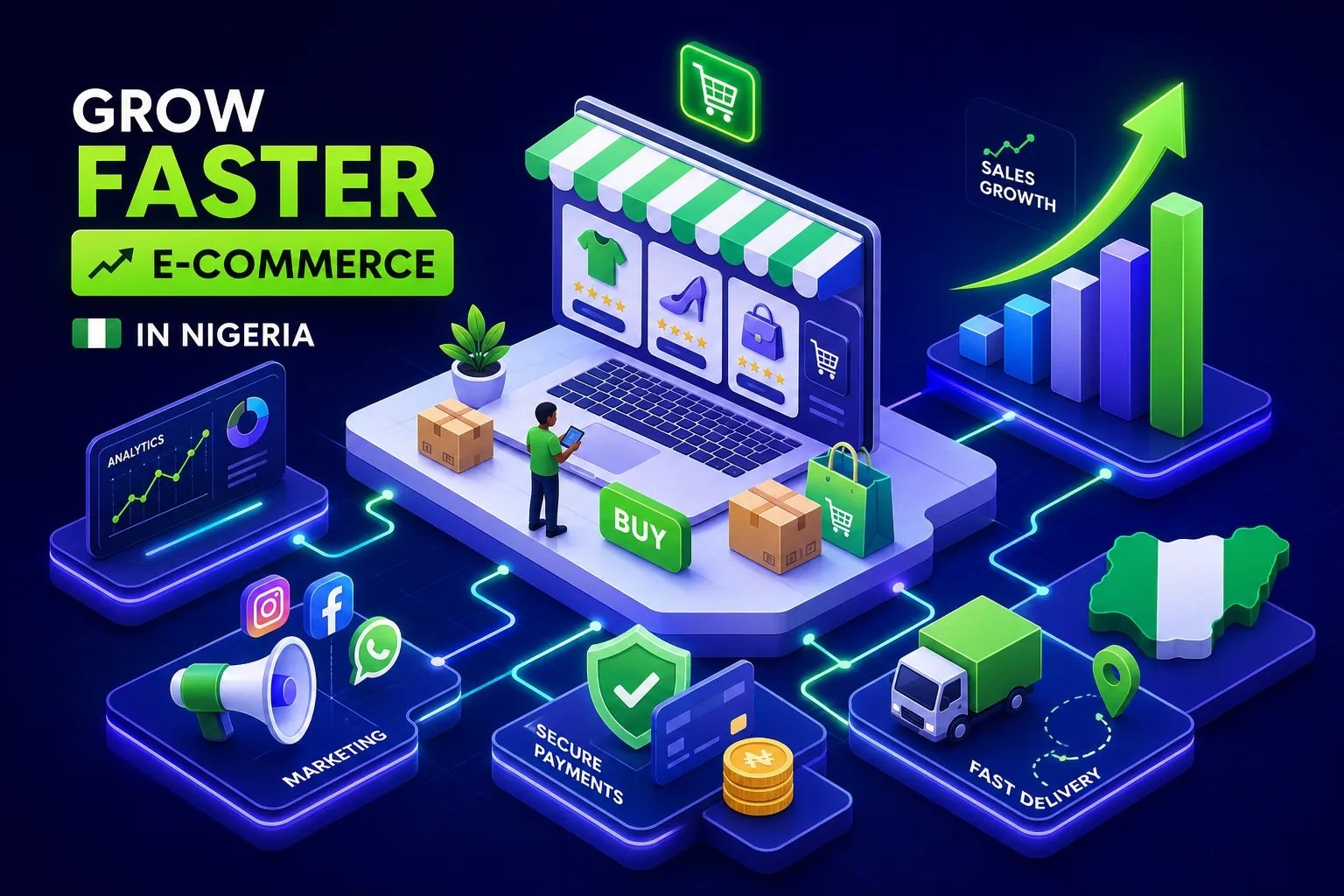
How can I grow my e-commerce business faster in Nigeria? The answer starts with six levers: better-targeted ads, a reliable fulfilment setup, fewer COD rejections, wider delivery coverage, stronger payment options, and disciplined profit reinvestment. Pull these in the right order and your revenue compounds. Pull only one while ignoring the others and you risk wasting every naira you put into ads. Nigeria now has 38 million online shoppers and 112 million internet users, yet most sellers stall because they scale their ad spend before fixing the operations underneath it. The result: rising costs, rising rejection rates, and shrinking margins.
This guide covers each lever in the order you should tackle it. Fix the foundation first, then pour fuel on it.
Key takeaways
- Operations before ads: Fixing your fulfilment, payment, and COD confirmation process first makes every naira of ad spend more profitable.
- Same-day delivery wins: Pre-positioning stock closer to your buyers dramatically reduces rejection rates and increases order completion.
- COD rejection is manageable: A simple pre-delivery confirmation workflow can cut rejection rates from roughly 25% to around 15%, based on industry estimates from practitioners using this method.
- Payment diversity matters: Checkout that only supports cards loses a significant share of Nigerian buyers who prefer NIP transfer, USSD, or e-wallets.
- Nationwide reach unlocks growth: Lagos-only sellers miss a substantial share of Nigeria’s 38 million online shoppers spread across Abuja, Port Harcourt, Kano, and beyond.
- Metrics drive reinvestment: Track four numbers consistently: AOV, CAC by channel, repeat purchase rate, and COD rejection rate.
How can I grow my e-commerce business faster in Nigeria? Start with ads that bring buyers, not just clicks
What buyer-intent targeting looks like for Nigerian sellers
The difference between an awareness audience and a buyer-intent audience on Meta is the difference between someone who scrolled past your ad and someone who pulled out their phone to place an order. Build your core targeting around lookalike audiences created from past purchasers, not from page followers or video viewers. Stack interests around specific product behaviours rather than broad demographic categories, and test wide targeting with strong creative alongside your interest-based sets. Practitioners running Nigerian campaigns report that broad targeting often outperforms narrow interest stacks when the creative is doing the heavy lifting, though results will vary by product category and audience size.
Mobile-first creatives are non-negotiable. With 89 million of Nigeria’s 112 million internet users accessing the web via mobile devices, vertical video, large legible text, and fast-loading formats are essential, especially for buyers on slower 3G connections common outside major urban centres. A creative built for desktop risks bleeding your budget on the wrong placements and underperforming on mobile-dominant inventory.
Why your creative matters more than your budget
Ad creative that converts in Nigeria tends to follow a recognisable pattern. Product demonstrations outperform lifestyle shots, price transparency in the creative itself removes friction, local language or Pidgin in captions builds instant relatability, and the call-to-action must match the COD purchase flow. These are practitioner-tested recommendations rather than universal rules, but they reflect the reality of how Nigerian buyers engage with social commerce. Your buyer is not clicking to a checkout page and entering card details; they are placing an order and expecting delivery. Your creative should reflect that reality.
A high click-through rate means nothing if the fulfilment behind the ad cannot deliver on the promise. That is exactly where most scaling attempts collapse, which brings us to the real bottleneck.
Why your fulfilment setup limits how fast you can grow
The hidden cost of relying on dispatch riders
Dispatch riders are not a logistics strategy; they are a workaround that becomes more expensive the bigger you grow. The actual costs go beyond the per-order fee. Inconsistent pickup times delay deliveries. No real-time tracking means you cannot tell your customer when to expect their order. Cash held by riders can sit unremitted for a day or more, locking up working capital you need to reinvest. Blended operational failure rates, covering both payment and delivery breakdowns, under informal setups can run 10 to 15% as a planning estimate, and that figure does not account for orders a rider cannot reach because they are on the wrong side of the city.
Every one of those failures eats margin. More critically, it kills customer trust. A buyer who waited four days and received a vague response when they asked for an update will not order from you again, and the lifetime value of that lost customer compounds with every repeat purchase they never make.
How a structured fulfilment partner removes the bottleneck
The fulfilment partner model works differently: stock is pre-positioned across multiple locations. When an order comes in, it is assigned and dispatched from the nearest hub, enabling same-day delivery. Payment is collected at the door and remitted to the merchant’s wallet, without a rider holding cash. Returns are managed on the merchant’s behalf, and every order status is visible in real time. Note that remittance timelines and automation features vary by provider, so confirm the specifics with any partner you evaluate.
Selligate E-commerce Fulfillments is a Nigerian-built example of this model, designed to give sellers coverage across multiple locations nationwide with same-day delivery and streamlined payment remittance. Selligate was founded by merchants who experienced these exact logistics failures while running their own online stores. That origin is why the platform is built around what sellers actually need, rather than what a generic courier company finds convenient. For any seller whose growth has plateaued, switching to a structured partner removes a significant operational bottleneck in one move.
How do you stop customers from rejecting COD orders?
What actually causes high rejection rates
Nigerian COD rejection rates for Facebook ad-driven orders sit at roughly 20 to 25% on average, and can climb above 30% for fashion and apparel. Three causes account for most of that: unverified customers placing impulsive orders with zero commitment, long delivery windows that give buyers time to change their minds or find a cheaper alternative, and no pre-delivery contact to confirm the order is still wanted. The rejection window and the delivery window are the same window. Shorten the delivery time and you automatically reduce the opportunity for cancellation.
Practical steps to cut cancellations before dispatch
The pre-delivery confirmation workflow is one of the most effective interventions available. Call or send a WhatsApp message within 30 minutes of an order coming in. Confirm the product, price, delivery fee, address, and a specific time window, then wait for the buyer to confirm before dispatching. Industry estimates from practitioners using this method suggest it can reduce rejection rates from around 25% to approximately 15%. For high-value orders, collecting a small delivery-fee deposit at checkout helps filter impulsive orders without eliminating COD entirely.
Sellers using a structured fulfilment partner with same-day delivery see lower rejection rates for a structural reason: the order fulfils before buyer intent fades. Send a tracking link the moment the order is assigned. Keep the buyer engaged between order placement and doorstep arrival, and the rate of “I don’t want it anymore” drops sharply.
Grow your e-commerce business faster in Nigeria, expand your delivery reach
Why staying Lagos-only is a growth ceiling
Nigeria’s 38 million online shoppers are not concentrated in Lagos. Buyers in Abuja, Port Harcourt, Kano, and Ibadan are actively searching for products and underserved by sellers who only ship from one city. The delivery economics make this worse: Lagos to Abuja through a structured courier typically costs between ₦6,000 and ₦12,000 for a standard parcel and takes two to four working days by standard service. At that cost and speed, your conversion rate drops sharply for buyers outside Lagos, same-day delivery becomes impossible, and COD rejection rates climb because the wait is too long.
Pre-positioning stock as the practical solution
The regional stock-point model solves this directly. Rather than shipping each order from Lagos, pre-position inventory in Abuja, Port Harcourt, or Kano. Orders in those cities fulfil from the local hub, enabling same-day delivery and better completion rates. Sellers using local pre-positioning consistently report lower COD rejection rates, the order arrives before buyer intent fades, which is the core structural advantage of this model.
This is how Selligate’s multi-location distribution network operates. A seller ships inventory in bulk once to the relevant hubs, then assigns individual orders through the app without touching logistics again. The per-order operational overhead stays flat even as order volume grows across multiple cities.
Give customers more ways to pay and fewer reasons to abandon
Payment gateways Nigeria: which methods shoppers actually use
Bank transfer via NIP is the highest-volume payment channel in Nigeria, particularly for purchases above a few thousand naira. Debit cards account for roughly 37% of the online payment mix, with Verve handling about half of domestic card transactions. USSD serves customers with basic phones or unreliable internet connections, which remains a significant segment outside major urban centres. E-wallets from platforms such as OPay, PalmPay, and Kuda account for approximately 10% of transactions. A checkout that supports only cards will lose a material share of potential buyers at the final step.
Paystack and Flutterwave are the most practical local gateways for covering most of these methods in a single integration. Both support NIP transfer, cards including Verve, USSD, and major wallets, the combination your checkout needs to minimise drop-off.
Reducing payment failures and checkout drop-off
Set bank transfer as the default checkout option rather than card, because NIP transfers generally produce lower failure rates than card processing. Display Naira pricing clearly and without currency ambiguity. Keep the mobile checkout flow to as few steps as possible; every additional screen costs you a percentage of buyers. Use retry logic for soft payment declines rather than showing a hard rejection message that sends the buyer away permanently.
Plan for an 85 to 90% initial payment completion rate as your baseline, then improve from there. The blended failure rate for Nigerian online payments sits at around 10 to 15% under typical conditions, and most of that is recoverable with better routing, fallback options, and clear transfer confirmation.
Track these numbers and reinvest profits to compound growth
The metrics that show whether your e-commerce business is actually growing
Four numbers give you a clear picture of whether your business is building or burning. Average Order Value (AOV): calculate it monthly and segment by city and payment method, not just store-wide. Customer Acquisition Cost (CAC) by channel: never blend paid social, organic, and influencer acquisition into one number, because it hides which channel is profitable and which is draining your budget. Repeat purchase rate: measure the percentage of customers who place a second order within 90 days. COD rejection rate: track it as a distinct operational metric, not buried inside a blended returns figure.
A dropping CAC alongside a rising repeat purchase rate is the clearest signal of a healthy, scalable business. When both move in the right direction simultaneously, it means your product is good, your targeting is improving, and your customers trust the experience enough to come back.
A simple reinvestment framework to accelerate the next growth phase
The 30/90/180-day sequence is an operational recommendation that many Nigerian sellers have found useful as a structured path. In the first 30 days, fix the operational levers: logistics partner, payment options, and COD confirmation process. In the first 90 days, test and stabilise one paid traffic channel until you have reliable CAC data. By 180 days, reinvest a defined percentage of profit into expanding delivery coverage to a second city using the regional stock-point model.
Each operational fix compounds. Better fulfilment raises your conversion rate on existing ad spend. Lower rejection rates raise the revenue you collect from orders already acquired. Wider coverage grows your addressable market without increasing your CAC. Every naira spent on ads produces a higher return when the operations behind it are solid.
The growth is in the operations, not just the ads
If you are asking how can I grow my e-commerce business faster in Nigeria, the honest answer is: less by spending more on ads, and more by removing the operational friction that wastes the spend you already have. The sequence matters, get your ad targeting right, fix fulfilment and COD logistics, cut your rejection rate with a pre-delivery confirmation workflow, expand coverage to a second city, and reinvest with clear metrics guiding each decision.
Sellers who switch from informal dispatch arrangements to a structured fulfilment partner like Selligate E-commerce Fulfillments typically find they have addressed a significant bottleneck in one move: same-day delivery, streamlined payment remittance, real-time tracking, and return management handled through one platform. That frees you to focus on what drives growth at the top of the funnel rather than firefighting logistics failures at the bottom.
The practical starting point is to audit whichever bottleneck is costing you the most right now. If your rejection rate is above 20%, start with the confirmation workflow and your fulfilment setup. If your checkout abandonment is high, start with payment methods. If your sales are flat despite rising ad spend, the operations underneath the ads need fixing before you increase the budget. Reach out to the team at Selligate E-commerce Fulfillments to discuss how a structured fulfilment setup can remove that bottleneck and help you scale across Nigeria.
Frequently Asked Questions
Can I get same-day delivery outside Lagos?
Yes, same-day delivery is possible outside Lagos when you pre-position stock in local hubs and use a structured fulfilment partner. I state that orders fulfil from the nearest hub in cities such as Abuja, Port Harcourt and Kano, enabling same-day delivery and lower rejection rates. Using a multi-location distribution network keeps per-order operational overhead flat as volume grows across cities.
How much can a pre-delivery confirmation workflow reduce COD rejections?
A pre-delivery confirmation workflow can reduce COD rejection rates from roughly 25% to around 15%. I explain that calling or sending a WhatsApp within 30 minutes to confirm product, price, delivery fee, address and a time window cuts impulsive cancellations, and for high-value orders a small deposit at checkout helps filter orders further.
Which payment methods should my checkout support to avoid losing buyers?
Your checkout should support NIP bank transfer, cards including Verve, USSD and major e-wallets. I note that bank transfer via NIP is the highest-volume channel for larger purchases, debit cards make up about 37% of the mix with Verve handling roughly half of domestic card transactions, USSD serves customers with basic phones, and e-wallets account for approximately 10% of transactions. Paystack and Flutterwave are the practical gateways that cover these methods in a single integration.
Will switching from dispatch riders to a fulfilment partner improve cash remittance?
Yes, switching to a structured fulfilment partner improves cash remittance because payment is collected at the door and remitted to the merchant’s wallet instead of sitting with riders. I point out that riders holding cash can lock up working capital for a day or more, whereas a fulfilment partner provides remittance timelines and real-time visibility that free up funds for reinvestment. You should confirm remittance specifics with any provider you evaluate.
What core metrics should I track to know if my business is growing?
Track Average Order Value (AOV), Customer Acquisition Cost (CAC) by channel, repeat purchase rate, and COD rejection rate. I advise calculating AOV monthly and segmenting by city and payment method, measuring CAC by channel rather than blending channels, checking the percentage who reorder within 90 days, and tracking COD rejection as a distinct operational metric. A falling CAC alongside a rising repeat purchase rate signals a healthy, scalable business.