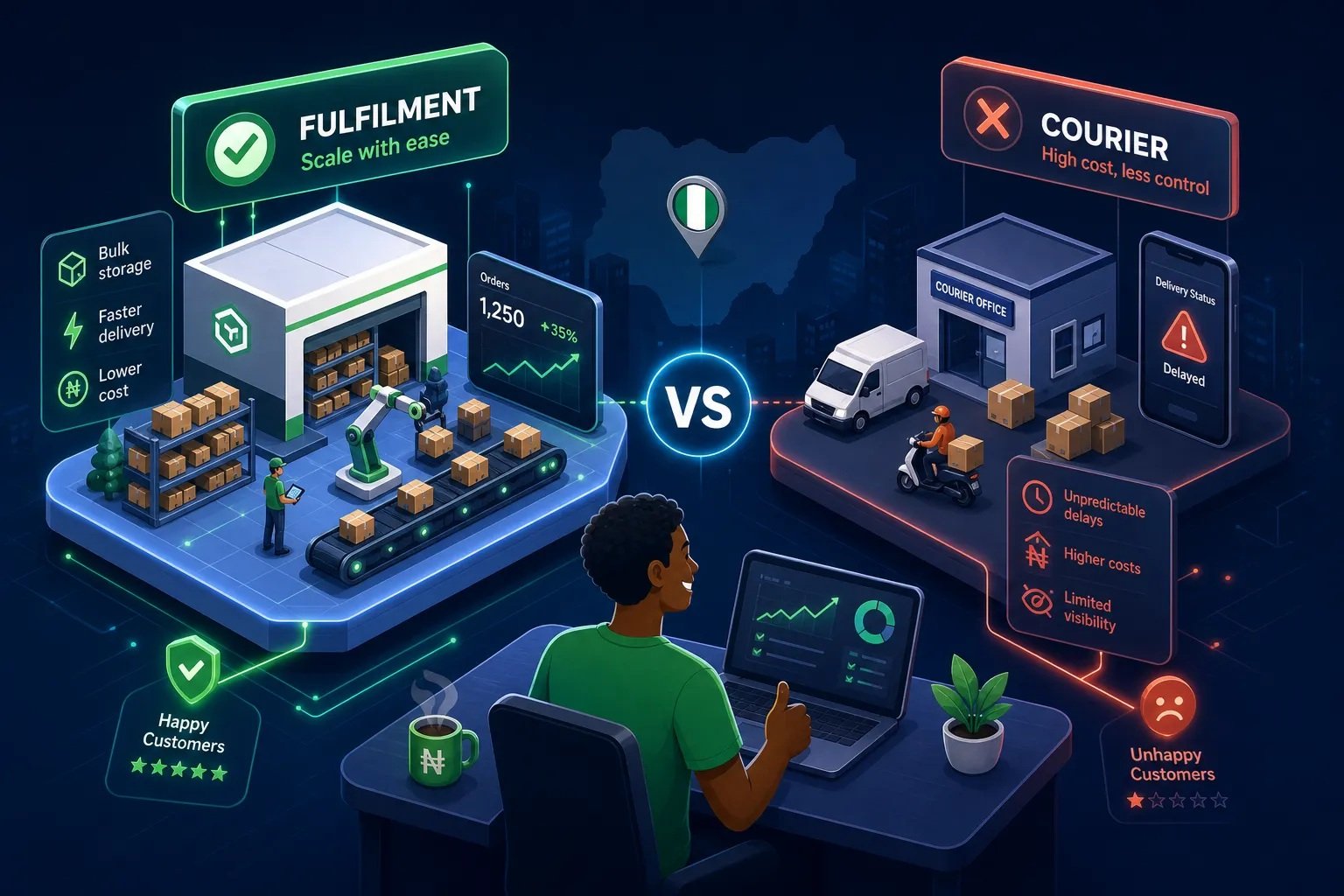
The e-commerce fulfilment vs courier decision is one of the most consequential choices a Nigerian online seller can make, and most sellers get it wrong by comparing the wrong numbers. A courier moves a parcel from your hands to your customer’s door. A fulfilment centre manages everything in between: storing your stock, packing each order, dispatching same-day, collecting COD payment, handling returns, and remitting the money directly to your account. Those are two very different services, and mixing them up costs Nigerian online sellers significant money every month.
This guide breaks down exactly what each model does, where each one makes financial sense, and how to use a five-step checklist to pick and onboard the right provider for your store. Whether you’re shipping 50 orders a month out of Lagos or scaling nationwide, this comparison will help you make a decision grounded in real numbers.
Many merchants report genuine operational relief after switching to full-service providers, understanding why requires looking at how each model actually works.
Key takeaways
- Couriers cover transit only: They move parcels but do not store stock, manage packing, or handle COD remittance as a structured system.
- Fulfilment centres cover the full lifecycle: Warehousing and fulfilment, from pick-and-pack through same-day dispatch, COD collection, and returns, are all handled in one pipeline.
- Speed cuts rejections: Nigeria’s COD rejection rate sits at roughly 20–30% (2026 industry estimate; figures vary by category and city); same-day delivery from pre-positioned stock collapses the window customers have to change their minds.
- Start evaluating at 100–200 orders per month: Begin comparing fully loaded costs at that range, pilot around 250–300, and expect the economics to favour a fulfilment partner clearly at 300–500 orders per month, depending on storage costs, labour, and geography.
- Remittance timelines matter: Standard Nigerian couriers remit COD payments in 3–7 days under typical arrangements, though timelines vary; some fulfilment providers advertise same-day or next-day remittance, verify exact timing in writing before signing.
- Pilot before committing: A 30-day test (or until you reach a representative sample of orders) with one product line or city gives you real performance data before you transfer all your stock.
What a courier service actually does (and where it stops)
A courier’s job begins when it picks up a parcel and ends when it delivers or attempts to deliver it. Everything before that point, sourcing, storage, packing, and labelling, is entirely your responsibility as the seller. The courier’s SLA covers transit time, not order preparation or post-delivery payment handling.
The typical Nigerian courier workflow runs like this: you pack at your home or office, book a pickup or drop-off at a hub, and the courier transports the parcel and attempts delivery. For COD orders, most Nigerian couriers treat cash collection as an add-on. They collect the money at the door and remit it later, usually within 3–7 days under standard arrangements, though some providers take 7–15 working days and informal operators can take longer. That remittance window is rarely a published SLA; it tends to live in a merchant agreement or in loosely worded marketing copy.
On top of the base delivery charge, you typically pay a COD collection fee (flat or percentage-based) and a return-to-sender charge when a customer refuses. When delivery fails, the courier returns the parcel and often bills you for the second leg. Address verification, confirmation calls, and redelivery attempts are handled inconsistently across providers, which contributes directly to Nigeria’s average COD rejection rate of roughly 20–30%. Sellers managing their own packing and booking have no buffer: one bad week of cancellations eats straight into margins.
E-commerce fulfilment vs courier: what a fulfilment centre actually covers
A fulfilment centre takes physical custody of your stock from the moment it arrives at the warehouse. You ship inventory in bulk to one or more locations; the provider stores it, counts it, and monitors it on your behalf. When an order comes in, the centre picks the item, packs it to the required standard, and generates the delivery label for same-day dispatch. All without you lifting a box.
Some 3PL providers operate across multiple distribution points nationwide, pre-positioning stock close to where your customers actually are, not just close to where you live. That single structural difference changes what same-day delivery means: it becomes operationally achievable for a customer in Abuja or Port Harcourt, not just for someone around the corner from your Lagos office. Selligate E-commerce Fulfillments is one provider built around this distributed model for the Nigerian market.
On the payment side, full-service fulfilment includes cash collection at the door, reconciliation, and remittance to the merchant’s account once delivery is confirmed. Structured providers typically offer faster turnaround than couriers, some advertise same-day or next-day crediting, though merchants should confirm exact timelines and conditions in writing. Real-time dashboards give sellers a live view of delivered, pending, and cancelled orders, so you’re making decisions based on data rather than guesswork from WhatsApp updates.
Returns and reverse logistics are also managed within the same system. When a customer rejects or returns an order, the fulfilment centre handles inspection, restocking or disposal, and, where applicable, replacement dispatch, all tracked in one place. With couriers, a return typically means a separate booking, a separate fee, and manual reconciliation on your side. Bringing returns inside the fulfilment platform keeps costs predictable and reduces the administrative load significantly.
Why COD rejection rates drop when you use a fulfilment partner
Nigeria’s average COD rejection rate of 20–30% is not a fixed number. It shifts with delivery speed, product category, and how professionally the delivery interaction is managed. Fulfilment partners are structured to address all three; courier-only models typically address none of them.
Speed is the biggest rejection fighter. COD rejections in Nigeria are often impulse-driven: the longer the gap between order placement and delivery, the more time a customer has to change their mind or simply not have the cash ready when the rider arrives. A fulfilment centre with stock already warehoused near the customer can dispatch same-day and deliver within hours, collapsing that decision window dramatically. A courier operating from a single Lagos address cannot offer this to a customer in Kano or Ibadan without adding 2–5 days of transit time.
Local stock positioning changes the economics in a measurable way. When inventory is pre-positioned across multiple locations, the delivery zone for same-day service expands to cover far more of your customer base. A fulfilment partner’s infrastructure effectively becomes the seller’s infrastructure, without requiring a dedicated warehouse in every city. Fewer rejections translate directly into more delivered orders, more COD payments collected, and a lower cost per successful sale.
Professional delivery handling also reduces friction at the door. Fulfilment partners train their agents specifically for COD environments: agents confirm orders before dispatch and communicate arrival windows, which reduces friction at the door considerably. Many general couriers do not specialise in merchant-branded COD interactions; they move high volumes of mixed parcels and are not always set up to manage the merchant-customer relationship during delivery. That difference in delivery behaviour, representing your brand versus simply dropping a box, directly affects how often a customer accepts and pays.
E-commerce fulfilment vs courier: cost and trade-offs at your order volume
Most sellers compare only the per-shipment courier rate. The full cost of the courier-only model includes packing labour, packaging materials, storage (whether rented or informal), failed-delivery charges, return-to-sender fees, and your own time. Once those are included, the comparison looks very different.
At low order volumes, under 100 per month, the courier model is usually cheaper on paper. Fulfilment centres often charge minimum monthly fees, storage fees, and onboarding charges that outweigh the savings at small volumes. Above 100–200 monthly orders, the seller’s time alone becomes a significant hidden cost. It rarely appears in any comparison, yet it is real. At 300–500 orders per month, most Nigerian sellers find that the fulfilment centre’s consolidated fees are comparable to or cheaper than the fully loaded courier cost, with significantly better service quality and lower rejection rates.
| Factor | Courier-only | Fulfilment center |
|---|---|---|
| Storage | Seller’s responsibility | Handled by the center |
| Packing | Seller’s time and labor | Handled by the center |
| Same-day delivery (multiple cities) | Difficult without multiple hubs | Built into the network |
| COD remittance | Variable; often 3–15 days | Structured; verify exact timeline in contract |
| Returns and reverse logistics | Manual; extra cost per return | Managed within the platform |
| Rejection risk | High with long transit times | Lower with local stock and fast dispatch |
| Stock reconciliations | Seller’s time and labor | Handled by the center |
Before signing with any provider, request a full breakdown: storage fees, pick-and-pack fees, packaging material charges, delivery fees by zone, COD collection fees, remittance timelines, return handling fees, and any minimum monthly spend. Comparing headline “price per order” figures without accounting for failed-delivery charges and reverse-logistics fees is one of the most common and costly mistakes sellers make in a high-COD market like Nigeria.
A 5-step checklist to choose and onboard the right provider
Step 1: Calculate your fully loaded logistics cost
Before comparing providers, total up everything you currently spend on storage, packing, courier fees, failed deliveries, returns, and your own time. This is your real baseline, not just the courier invoice. If you don’t have this number, track one month of orders in detail. Most sellers are genuinely surprised by how much failed deliveries and packing labour add up to once they sit down and count.
Step 2: Define your delivery geography and speed requirements
Map where your customers actually are. If a significant portion of your orders go outside Lagos, a courier arrangement based on a single Lagos dispatch point will consistently produce slow deliveries and elevated rejection rates. A fulfilment partner with distributed warehousing solves this structurally; a courier partnership does not. This step alone often clarifies the decision.
Step 3: Audit COD handling and remittance terms
Request the provider’s COD settlement timeline in writing. Ask specifically: how many days after successful delivery is payment remitted? What happens when an order is refused or partially paid? Who covers the return cost? Providers who cannot answer these questions specifically are relying on informal processes that will cause cash-flow problems as your volume grows.
Pilot: testing e-commerce fulfilment vs courier approaches before committing fully
Run a 30-day pilot, or continue until you reach a meaningful sample of orders, with one product line or one city before transferring all your stock. Measure delivery success rate, COD collection rate, remittance accuracy, and return-handling speed. A legitimate fulfilment partner will support a structured onboarding process. One that resists a pilot is worth questioning.
Step 5: Choose a provider built for the Nigerian COD environment
Generic couriers are built for parcel movement. Full-service fulfilment providers are built for the complete order lifecycle, including the payment and returns complexity that COD adds. Look for a provider built around this problem specifically, one with firsthand experience of COD rejections and remittance delays, not just parcel logistics. Selligate E-commerce Fulfillments, for example, was designed for the Nigerian COD environment from the ground up. The onboarding process is straightforward: register as a merchant, add your products, select your distributor locations, ship stock in, and start assigning orders through the app.
Making the decision that fits your business today
A courier moves your parcel. A fulfilment centre runs the operation around it. In a market where roughly 70% of Nigerian consumers prefer pay-on-delivery (2026 industry estimate) and average rejection rates run at 20–30%, the gap between these two options is not academic. When comparing e-commerce fulfilment vs courier for your Nigerian store, that gap directly determines how many of your orders convert into actual revenue.
The order volume at which the switch becomes compelling is clear from the data: start evaluating at 20–50 orders per month, run a pilot at around 50–100, and expect the economics to clearly favor fulfillment at 50–500 orders per month. That calculation shifts earlier if you’re paying warehouse rent, hiring packing staff, or fulfilling significant interstate volume.
If you’re ready to move beyond the courier-only model, get in touch with the Selligate team. The infrastructure, the distribution network, and the COD expertise are already in place. Your next step is simply putting your stock inside the system.
Frequently Asked Questions
If I’m doing under 20 orders a month, should I switch to a fulfillment center?
No, I would generally not switch at under 100 orders a month because the courier-only model is usually cheaper on paper at very low volumes. I advise you to tally your fully loaded costs first, storage, packing labour, failed deliveries and your time, and only begin evaluating fulfilment once you hit roughly 100–200 orders per month.
How long will COD payments take to reach my account if I use a fulfilment partner compared with a courier?
Fulfilment partners typically remit faster than standard couriers, with some advertising same-day or next-day crediting, while couriers commonly remit COD in about 3–7 days and some take 7–15 working days. I recommend getting the exact COD settlement timeline in writing from any provider before you sign.
What exactly should I measure during a 30-day pilot to decide between courier and fulfilment?
Measure delivery success rate, COD collection rate, remittance accuracy and return-handling speed during the pilot. I also advise you to use one product line or one city so you get a representative sample and can compare fully loaded costs and operational relief.
How does a fulfilment centre actually reduce COD rejection rates for my store?
A fulfilment centre reduces COD rejections by pre-positioning stock for same-day dispatch, shortening the decision window for customers, and training delivery agents for merchant-branded COD interactions. I can confirm that local stock positioning, faster delivery and professional delivery behaviour all combine to cut rejections from Nigeria’s average COD rejection rate of roughly 20–30%.