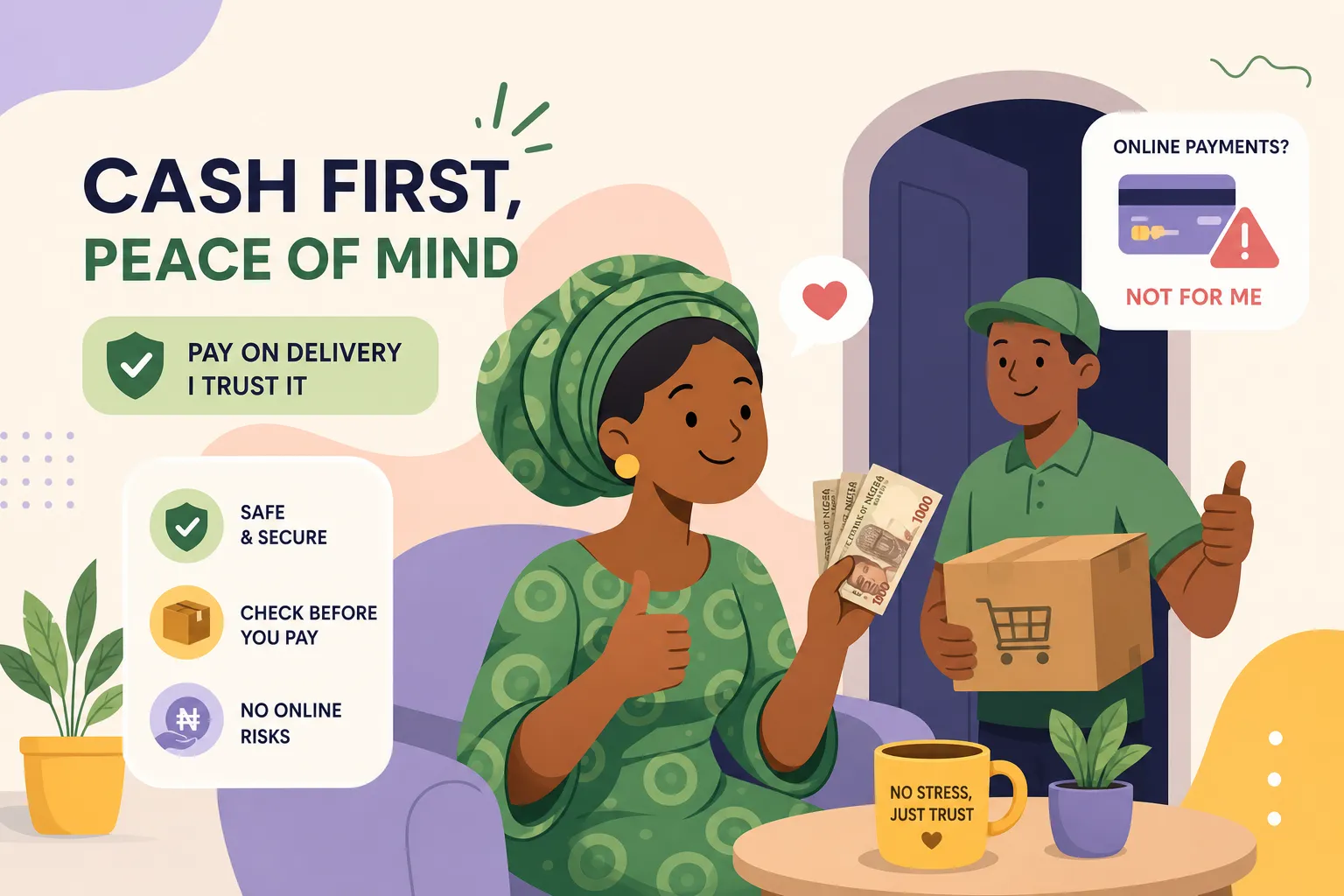
Why do Nigerians prefer pay on delivery over online payment? The answer is grounded in lived experience, not habit. Nigeria has one of the most digitally active populations in Africa, yet a significant share of those shoppers will not hand over money until a product is sitting right in front of them. That is not backwardness. It is a rational response to a market that repeatedly punished people for trusting it.
Cash on delivery (COD) did not rise to prominence in Nigerian e-commerce by accident. It grew because prepaid online payment kept failing people: fraud, product misrepresentation, failed transactions, and no reliable path to getting money back. The preference is the market’s verdict on a broken trust infrastructure. Data confirms it is shifting slowly, from roughly 15% of e-commerce transactions in 2025 to a projected 9% by 2027, passing through an estimated 12, 13% in 2026, but that still represents millions of orders. For merchants who want to build a profitable business in this environment, understanding why the preference exists matters far more than wishing it would disappear.
This article covers the trust deficit, the infrastructure gaps, the cultural economics, and what merchants can do with that knowledge. Operators like Selligate E-commerce Fulfillments built their entire model around this reality, not by fighting it, but by building the infrastructure to serve it profitably.
A trust deficit built on real, painful experiences
The Nigerian shopper’s preference for cash on delivery is not a quirk. It is the accumulated result of a market where being cheated online became common enough to shape an entire generation’s behaviour. Three experiences in particular drove it.
The fraud history that conditioned how Nigerians evaluate online stores
Advance-fee fraud, fake online storefronts, and social media scams trained many Nigerians to treat prepaid payments as inherently risky. The mechanics are well-documented: a seller advertises on Facebook or Instagram, collects payment, then disappears or delivers something worthless. Once that happens to you, or to someone you know, the default assumption changes. Every new online store becomes a potential threat until proven otherwise. Recovery and enforcement mechanisms for e-commerce disputes remain limited and slow in practice, which means every prepaid transaction carries a tail risk the buyer cannot easily hedge.
The “what I ordered versus what I got” problem
Product misrepresentation is persistent in Nigerian e-commerce. Items that look premium in photos arrive cheap, wrong-sized, or completely different from the listing. COD gives the buyer practical leverage: inspect first, pay only if satisfied. In the absence of a credible consumer protection framework, this is not preference, it is self-defence. The buyer who pays upfront has no recourse once the parcel is opened. The buyer who pays on delivery can simply refuse.
No consumer protection safety net to catch falling shoppers
Nigeria’s Federal Competition and Consumer Protection Act (FCCPA) 2018 provides a legal foundation for consumer rights, but enforcement in e-commerce disputes remains limited. There is no straightforward, fast mechanism for a shopper to dispute a transaction and recover funds from an unscrupulous online seller. Pay on delivery fills the protection gap that regulation should be providing. Until enforcement genuinely catches up, COD remains the most accessible form of consumer protection available to the average Nigerian shopper.
Why do Nigerians prefer pay on delivery: cards and digital wallets still face real barriers
Even Nigerians who are willing to pay online encounter genuine infrastructure problems. The decision to use COD is not always ideological. Sometimes it is simply the only practical option available.
Low card penetration beyond Nigeria’s urban centers
National debit card penetration sat at approximately 35% in 2021 (World Bank; see debit card penetration data). Regional breakdowns beyond that national figure are not readily available in published sources, but penetration is widely understood to be lower outside Lagos and Abuja, given the concentration of formal banking infrastructure in major cities. Many shoppers in smaller cities and rural areas have bank accounts accessible via USSD, but lack the card credentials most online checkout systems require. For those shoppers, COD is not a preference, it is the only viable way to buy from an online store. Bank transfers, which now account for roughly 52% of digital payment transactions, dominate the prepaid space precisely because they do not require a card.
Transaction failures that erode confidence in prepaid systems
Even card owners face repeated frustration: declined payments, double debits, failed OTP confirmations, and network downtime. A shopper who has lost money to a failed transaction and then waited three weeks for a reversal is not going to extend trust to an unfamiliar online store. The experience creates a rational rule: do not pay upfront to a seller you cannot verify. That rule survives even as digital infrastructure improves, because the memory of failure outlasts the infrastructure fix.
Why trust in the payment system and trust in the seller are separate problems
Most Nigerians trust interbank transfers for bills and peer-to-peer payments. What they do not trust is paying an unverified online store before seeing the goods. Mobile money and card payments in Nigeria face an additional credibility layer that pure payment-infrastructure improvements cannot resolve: seller verification. The issue is seller credibility, not payment technology. That distinction matters enormously for merchants trying to increase prepaid adoption. Fixing payment infrastructure alone does not solve the problem. Building verified seller credibility does.
The cultural economics of paying with cash
Nigeria’s market culture runs deep. Long before e-commerce existed, the standard transaction model was inspect, negotiate, then pay. COD maps directly onto that lived experience.
Inspect before you buy: a behaviour rooted in market culture
In Balogun Market, Onitsha Main Market, or any roadside trade, no buyer hands over money before handling the goods. E-commerce that demands prepayment asks shoppers to break a behaviour that has been economically rational for decades. COD preserves the familiar sequence: see it, confirm it, pay for it. That sequence is not a flaw in the Nigerian consumer. It is a feature of a market that taught its participants to be careful.
Cash as certainty in an uncertain economy
In a high-inflation environment where purchasing power shifts constantly, physical cash retains a psychological weight that a digital debit does not. Paying with cash at the door is a transaction the buyer controls from start to finish. The money stays in hand until the moment of satisfaction. That sense of control is not trivial when economic conditions are unpredictable and financial stress is common.
The social proof gap for small online stores
Established platforms have gradually built enough brand recognition to push more prepaid transactions. But the majority of Nigerian e-commerce happens on small merchant websites, Facebook pages, and Instagram shops, operated by sellers with no visible track record, no verified reviews, and no institutional credibility. For those stores, COD is often the only offer that converts a first-time visitor into an actual buyer. It is the trust substitute when brand equity does not yet exist. This is precisely where COD vs online payment decisions are made, and COD wins by default.
What cash on delivery actually costs the merchant
COD drives conversions. It also carries a significant operational cost that many merchants underestimate until it has already damaged their margins.
Return-to-origin rates that eat into margins
In comparable developing markets such as India and parts of Southeast Asia, COD orders return at rates of 25, 40%, versus 2, 3% for prepaid orders. Each failed delivery carries a reverse shipping fee, lost inventory time, and administrative overhead. A merchant running 35% rejection rates on high order volumes is not building a profitable business. They are running an expensive logistics loop that looks viable at checkout and falls apart at the operational level. Nigeria-specific data on RTO rates is limited, but the structural dynamics, recipient unavailability, impulse-driven orders, no financial commitment at checkout, are directly comparable. For broader market context, see Nigeria e‑commerce market data.
Cash flow delays that strain working capital
Unlike prepaid orders that settle near-instantly, COD payments depend on a courier or fulfilment partner collecting cash and remitting it back. In many arrangements, that cycle runs 7, 30 days, based on typical courier remittance terms documented across the sector. For a merchant restocking inventory weekly, that gap is the difference between scaling and stalling. The working capital tied up in unremitted COD collections is invisible on a revenue spreadsheet but very visible in a bank account balance.
The hidden cost of multiple delivery attempts
COD orders require significantly more delivery attempts per successful transaction. Data from comparable developing markets shows COD averaging 1.87 delivery attempts per success, versus 1.12 for prepaid orders, a difference of roughly 67% more time, fuel, and driver effort per COD order. The unit economics that look viable at checkout deteriorate once you factor in those additional attempts. Most merchant spreadsheets do not capture this until the damage is already visible in the financials.
How smart merchants are turning COD into a competitive advantage
The merchants who thrive in Nigeria’s COD market are not the ones trying to educate customers out of their preference. They are the ones who have built operations precise enough to make cash on delivery consistently profitable.
Meeting customers at the point their trust actually sits
The preference for pay on delivery is not disappearing quickly. The data projects it declining from around 15% of e-commerce transactions in 2025 to approximately 9% by 2027, but that still represents millions of transactions annually. Merchants who eliminate COD as an option lose conversions to competitors who still offer it. The better strategy is making COD operationally tight: same-day delivery, verified customer contact before dispatch, and prompt payment collection at the door. Speed and reliability are what separate profitable COD operations from loss-making ones. See one industry e‑commerce market forecast supporting this trajectory.
Why fulfilment infrastructure determines whether COD is profitable or painful
The merchant who drops parcels off with a generic dispatch rider faces every COD problem at full intensity: high rejection rates, slow remittances, and zero accountability when an order goes missing. The merchant whose stock sits pre-positioned in fulfilment hubs close to their customers, dispatched same day and tracked in real time, has a structurally different experience. That is the model Selligate E-commerce Fulfillments was built around, with distribution points across major cities nationwide, same-day delivery capability, automatic wallet crediting once payment is collected, and return management handled end-to-end. When the infrastructure is right, the COD rejection rate drops, the remittance cycle shortens, and the per-order economics improve significantly.
Practical steps merchants can take right now to reduce COD losses
Three operational changes make an immediate difference.
First, pre-qualify high-risk COD orders by confirming via phone call before dispatch. A customer who confirms the order verbally is far less likely to reject at the door.
Second, stock inventory closer to high-demand regions to enable genuine same-day fulfilment. The longer the delivery window, the higher the rejection rate.
Third, work with a fulfilment partner that remits payments promptly, so cash flow does not stall between delivery and restocking.
These are not technology fixes. They are operational discipline changes that shift the economics of COD from a liability towards a conversion advantage.
The bottom line: why Nigerians prefer pay on delivery over online payment
Nigerian shoppers choose cash on delivery because the market gave them very good reasons to. Fraud, product mismatch, payment failures, and the absence of robust consumer protection are not irrational fears. They are documented experiences shared across income levels, cities, and demographics. Until the trust infrastructure genuinely improves, COD will remain a significant e-commerce payment preference in Nigeria, not an anomaly to be explained away.
The merchants who understand this stop treating pay on delivery as a problem to eliminate and start treating it as a distribution reality to optimise around. When your fulfilment operation is fast enough to deliver same-day and reliable enough to collect payment on the first attempt, COD becomes a conversion advantage, not a liability. That shift in thinking is where profitable Nigerian e-commerce businesses are being built right now.
As digital wallets grow and consumer protection frameworks mature, prepaid adoption will rise. But the merchants who win that next phase will be the ones who earned customer trust during the COD era, by showing up reliably, delivering accurately, and handling returns without drama. Industry estimates also point to rapid sector growth, some reports expect Nigeria’s e‑commerce transactions to reach US$33bn by 2026. That track record is not tied to a payment method. It comes from operational excellence, compounding with every repeat buyer who returns because the first delivery went exactly as promised.