Many social sellers in Nigeria report choosing a courier the same way they choose a restaurant: based on a recommendation in a WhatsApp group. That approach works until a batch of orders gets rejected, remittance is delayed by two weeks, and returned items pile up with no clear process. The right logistics company for Facebook and Instagram sellers in Nigeria is not simply the fastest bike or the cheapest per-shipment rate. It is the one built for how social commerce actually operates: COD-heavy, ad-driven, high-volume, and spread across states your dispatch rider has never visited.
This guide gives you a practical framework to evaluate your options and land on a confident decision. Whether you are processing 30 orders a week or 300, the questions you ask a potential logistics partner will determine whether your cash flow stays healthy or gets strangled between delivery day and remittance day. Purpose-built fulfilment platforms like Selligate E-commerce Fulfillments exist precisely because generic couriers were not designed with the social seller in mind. That distinction matters more than most sellers realise until they experience the consequences.
Why social sellers keep picking the wrong logistics partner
Most sellers start with dispatch riders or the courier their supplier recommends. For a handful of orders per week, that arrangement holds. Once ad spend increases and order volume climbs, pickup delays, lost parcels, and zero visibility into delivery status become daily friction that eats into margins and customer trust simultaneously.
The bigger issue is what COD does to the logistics equation. When your buyers prefer to pay on delivery, and industry estimates suggest COD rejection rates in Nigeria run between 15 and 30 percent for social commerce sellers, your logistics partner is not just moving a parcel. They are collecting cash on your behalf and holding it until remittance. The reliability of that remittance cycle matters as much as delivery speed, yet most sellers never ask about it before signing up.
Couriers advertise delivery timelines prominently and remittance timelines almost never. A courier that delivers in 24 hours but holds your COD funds for 14 days is a cash-flow problem disguised as a logistics solution. If your Facebook ad campaign budget refreshes every week and your payments arrive every fortnight, the mismatch will eventually stall your growth, regardless of how fast the parcels move.
The 4 factors that separate a reliable logistics partner from a costly mistake
Before you compare specific courier names, build your evaluation around four factors that directly affect a social seller’s business performance. These are not theoretical criteria; they are the exact areas where sellers lose money silently each month.
Same-day delivery capability requires more than speed. It requires inventory already positioned close to your buyers. Without pre-positioned stock or a dense network of distribution points, same-day delivery is a marketing claim that only holds inside Lagos. For a seller whose Instagram campaign brings in buyers from Abuja, Port Harcourt, and Kano on the same day, “same-day” means nothing if it only applies to one city.
COD remittance speed is the factor with the most direct impact on your ad budget. Timelines across Nigerian providers vary significantly, from near-immediate crediting at some fulfilment platforms to five or more working days with conventional courier services. For a seller reinvesting COD revenue into the next round of ads, even a 7-day gap is not a minor inconvenience. It is a structural constraint on how fast you can scale.
Return and rejection handling is where many sellers discover hidden costs too late. No courier eliminates rejections entirely. The real question is whether the partner charges you for failed delivery attempts, how quickly rejected items re-enter your available stock, and whether there is a defined process or just a phone number that rings out.
Geographic coverage is the final factor, and Lagos metro is the wrong benchmark. The real test is whether your partner has physical infrastructure in Abuja, Port Harcourt, Kano, and Ibadan, not merely listed those cities on a website.
Which logistics company works best for Facebook and Instagram sellers in Nigeria: COD courier comparison
A significant development that every social seller needs to know: as of May 2026, GIG Logistics (GIGL) discontinued cash-on-delivery for e-commerce orders in Nigeria. GIGL was one of the most widely cited COD options for merchants, known for its nationwide route network and a remittance timeline that historically ran to five or seven working days. That option is no longer available for new COD shipments, which meaningfully narrows the field for sellers who had been relying on or considering GIGL.
Kwik Delivery and Gokada, same-day urban delivery
Kwik Delivery and Gokada remain strong options for same-day urban delivery within Lagos and Abuja, with Kwik quoting 2, 4 hours for city orders. Their COD structure requires merchants to fund a Kwik wallet upfront to cover the delivery fee, plus a return fee equal to 60 percent of the delivery charge. If the buyer accepts the order, that return fee is refunded. If the order is rejected, the merchant absorbs the cost. Kwik states a 24-working-hour settlement timeline after successful delivery. Both platforms work best as supplementary partners for campaigns targeting a single city, rather than as primary nationwide solutions.
Sendbox, multi-carrier aggregator
Sendbox and comparable multi-carrier aggregators centralise shipment booking under one dashboard, which simplifies the administrative side of shipping management. Their merchant portal includes real-time tracking, shipment history, and dynamic rate quotes, along with an escrow-style flow that holds payment until delivery is confirmed. The limitation is worth examining carefully: aggregating carriers may not fully standardise COD remittance terms across the underlying operators. Sellers should verify settlement timelines and returns handling for each carrier within the aggregator’s network, as terms can vary and issues may involve an additional layer of co-ordination to resolve.
The common gap across traditional courier options
The common gap across traditional parcel carriers is that they are fundamentally transportation businesses. They move parcels. Most do not warehouse your inventory, manage returns on your behalf, or credit your account at the point of delivery. For a social seller running daily ad campaigns and needing to reinvest revenue quickly, that gap is not a minor limitation. It is why logistics keeps breaking at scale.
What a fulfilment-first model does that general-purpose carriers cannot
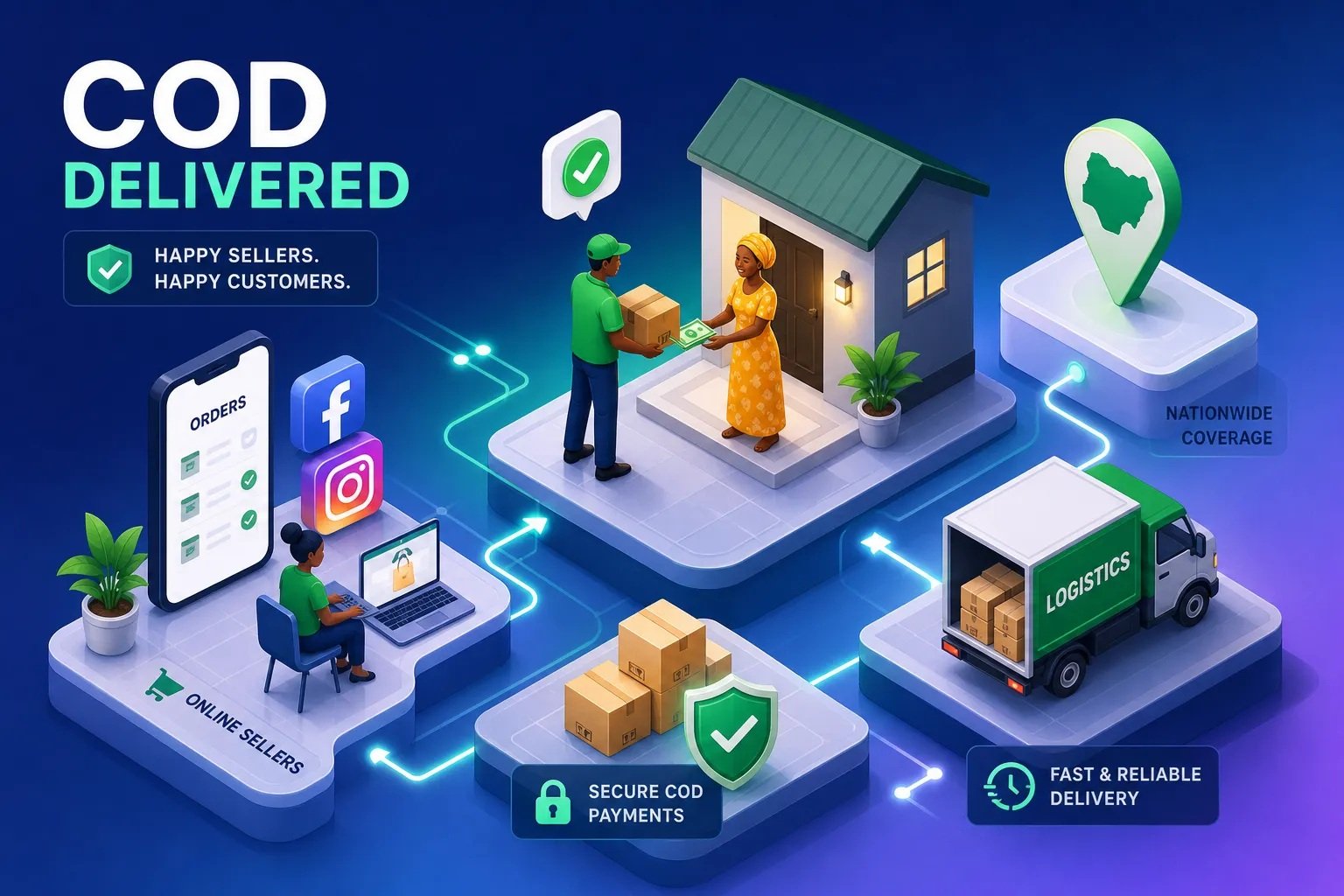
A fulfilment-first model means your products are stored in distribution points positioned close to where your buyers actually are, rather than sitting in a single location waiting to be dispatched cross-country. When an order comes in from a Facebook ad, it ships from the nearest stocked location rather than making the journey from your home in Lagos to a buyer in Enugu. That is how same-day delivery across multiple states becomes an operational reality instead of an aspirational claim. Selligate E-commerce Fulfillments operates on exactly this model, with distribution points covering major commercial cities across Nigeria and expanding coverage for sellers who have outgrown Lagos-centric logistics.
On remittance, the difference is structural. When a customer pays on delivery through a fulfilment-first platform, the merchant’s wallet is credited automatically, no weekly batch processing, no multi-day wait, no manual reconciliation. Selligate advertises same-day wallet crediting for successful deliveries; verify the current terms directly with the platform when you onboard, as operational details can evolve. For sellers reinvesting COD revenue into the next round of Facebook or Instagram ads, near-immediate wallet crediting is a competitive advantage that general-purpose carriers cannot offer without fundamentally restructuring their business model.
Return handling works differently too. When a delivery fails or a customer rejects an order, the item goes back into the nearest distribution point rather than sitting in a courier depot or making the expensive journey back to your base. The fulfilment model absorbs the return loop so you can reassign the product to the next order without losing days of inventory visibility. Selligate was built around the practical problems Nigerian social sellers face with COD rejections, remittance delays, and logistics failures. The features it offers, including real-time order tracking, automatic wallet crediting, return management, and a merchant app with full sales history, address problems that traditional courier services have never had strong commercial incentives to solve.
Questions to ask any logistics partner before you commit
Whichever partner you are evaluating, these questions will surface operational realities that websites and sales calls tend to skip over. Ask them directly; treat vague or deflected answers as a reliable signal that the operational gap is real.
On COD collection and payment:
- How long after a successful delivery does payment reach my account?
- Is there a COD handling fee, and does it change at higher order volumes?
- What happens if the rider cannot collect payment at the door?
On coverage and same-day capability:
- Which specific states and cities can you deliver to on the same day?
- Do you have physical infrastructure in those locations, or do you subcontract to local operators?
- How do you handle deliveries to less-urbanised areas within your covered states?
On returns, rejections, and merchant tools:
- What is your formal process when a customer rejects an order at the door?
- Am I charged for failed delivery attempts?
- Do you have a merchant dashboard where I can track delivered, pending, and cancelled orders separately, and access a full withdrawal history?
Matching your business to the right delivery model
If you are early-stage, selling only within Lagos, and processing fewer than 30 orders per week, a same-day urban courier like Kwik or Gokada can work. The priority at this stage is speed and a low per-order cost. You can tolerate a 24-hour remittance cycle because volume is manageable and cash pressure is lower. Test with a small batch before committing, and track your rejection rate from the first week.
If you are running consistent Facebook or Instagram ad campaigns and COD accounts for more than 70 percent of your orders, remittance speed and rejection handling become your primary metrics. A courier that takes 7 days to pay you while your next ad campaign starts in 3 days is structurally misaligned with your business model. A fulfilment partner with fast, automatic wallet crediting fits the cash-flow rhythm of ad-driven social commerce in a way that conventional carriers do not.
If you are expanding beyond Lagos or already generating orders from multiple states, geographic reach alone is not sufficient. You need a partner with inventory infrastructure in your target states, not a carrier that subcontracts to local operators with inconsistent service quality. Pre-positioned inventory and a nationwide distribution network are what separate real coverage from a list of city names on a features page.
The practical way to make this decision is to pull three numbers from your own data: your orders by state for the last 30 days, the number of days between delivery confirmation and when funds land in your account, and your monthly rejection rate. Those three figures will point you toward either a specialist urban courier or a full fulfilment partner faster than any recommendation from a group chat.
The right partner aligns with how social commerce actually works
So what logistics company works best for Facebook and Instagram sellers in Nigeria? The honest answer depends on your order volume, geographic reach, and how tightly your ad budget is tied to COD revenue. Conventional carriers serve a legitimate purpose, but they were not designed around the merchant experience of a Nigerian social seller. Evaluating logistics partners against same-day capability, COD remittance speed, return handling, and genuine geographic depth moves you from guessing to deciding with data behind you.
Whichever partner you shortlist, run a controlled test batch of 20, 30 orders before full commitment. Track delivery time, fund settlement time, rejection rate, and how returns are processed. The gap between what a logistics company promises and what it delivers consistently at scale is where most sellers lose money they never see itemised on any invoice.
If your business has outgrown the limitations of general-purpose carriers, a fulfilment-first platform built specifically for the Nigerian social commerce context is worth examining closely. Selligate E-commerce Fulfillments offers a merchant onboarding process designed to get products into the right distribution points quickly, so that fast delivery, prompt remittance, and return management work together as a single system rather than creating separate problems to manage. Visit the Selligate platform to review the onboarding process and register your merchant account.