How to offer same day delivery to customers across Nigeria? It is a question every growing online seller eventually asks. A customer in Abuja sees your product, places an order, and expects it fast. Your stock is sitting in your Lagos apartment. The fastest interstate courier on that corridor takes 24 to 48 hours minimum, and you are paying between ₦6,000 and ₦12,000 per parcel. Same-day delivery across Nigeria starts to feel like a lie you cannot keep making.
The problem is not your courier. The problem is where your stock lives before the order even arrives. Sellers who crack nationwide same-day delivery are not using faster bikes or premium express services. They pre-position their inventory inside the cities their customers order from, so delivery is always a short last-mile trip, never a cross-country race. That is the model this guide is built on, and it is exactly the infrastructure that Selligate E-commerce Fulfillments has built for Nigerian merchants who want to deliver the same day without managing warehouses in five cities.
Why same-day interstate delivery is a myth (and what actually works)
No major Nigerian courier offers genuine same-day delivery across state lines. CourierPlus guarantees same-day service only to selected airport cities for shipments received before 10:00am. Red Star Express cuts off at 1:00pm for late-evening same-day delivery within supported cities. GIG Logistics’ fastest interstate option is a 24-hour next-day service. The hard floor on corridors like Lagos to Abuja or Lagos to Port Harcourt is 24 to 48 hours, regardless of which courier you call. That is a logistics constraint, not a service gap anyone is about to fix in the near term.
What works is a completely different approach. If your product is already stored inside Abuja before a customer there places an order, the delivery is a short city run, not a cross-country haul. That last-mile trip is fully achievable within hours. This is called inventory pre-positioning, and it is the only model that makes same-day fulfilment across Nigeria real for an online seller operating at any scale.
This also reframes what “nationwide same-day delivery” actually means. You are not trying to sprint products across the country in hours. You are building a presence inside enough cities that every order feels local. The goal is city-by-city coverage, not a one-warehouse-fits-all approach. Once you understand that distinction, the rest of this guide becomes very practical.
Map where your customers actually order from
Before you commit a single naira to storage in a new city, pull your order data and sort it by delivery state and city. Most sellers who do this find their orders cluster heavily in a handful of locations. According to available Nigerian e-commerce market data, greater Lagos accounts for roughly 39% of orders, while Abuja and Port Harcourt together contribute another 25%. If your own data mirrors those market patterns, you already know your three highest-priority cities for same-day coverage, and that is precisely where to start.
Trying to cover all 36 states at once is how sellers waste money and exhaust themselves. Start with your three or four highest-volume cities, get the operation right there, and expand only once the model is working. A Lagos-based device seller, for example, might ship a bulk stock position to Abuja and Port Harcourt first, offer same-day delivery in those three cities, and then add Kano and Ibadan once the remittance and return processes are running smoothly. Scaling a broken model faster only amplifies the damage.
Pre-position your inventory before orders arrive
Inventory pre-positioning means shipping your products in bulk to storage points across your target cities in advance of any specific order. When a customer places an order, the item is already close to them. Dispatch happens within hours, not days. This is fundamentally different from the single-warehouse model where you pick, pack, and hand over to a courier after the order drops.
To decide how much stock to send where, use four to six weeks of order history per city as a practical baseline. Estimate weekly sell-through volume for each location, factor in your lead time to replenish, and set reorder triggers so each location stays stocked. Erring on the side of slightly too much stock at a location is far better than a stockout when you are running a same-day promise. A stockout in Abuja does not just cost you one sale, it damages the delivery commitment you have marketed.
Building and leasing private warehouse space in five cities is often impractical for small and medium-scale Nigerian sellers. The capital outlay, staffing, and management complexity can be prohibitive at that stage. This is where a fulfillment network changes the equation entirely. Selligate E-commerce Fulfillments stores merchants’ products across multiple distribution points nationwide, so when an order comes in, dispatch goes out from the location closest to the customer the same day. You ship stock in bulk to Selligate’s network; Selligate handles the rest from there.
How can I offer same-day delivery: choosing the right fulfilment partner
A courier picks up a parcel and drops it off. A fulfilment partner warehouses your stock, assigns orders through a platform, dispatches on your behalf, collects COD payment, and remits your funds. That distinction matters at scale. The courier model works for occasional deliveries; it breaks down when you are running 50 to 200 orders per day across multiple cities and need reliable tracking, return handling, and timely remittance for every single one.
When evaluating any same-day fulfilment partner in Nigeria, these are the non-negotiables:
- Nationwide storage coverage across your target cities, not just Lagos
- Same-day dispatch capability once an order is assigned
- COD collection with fast, reliable remittance to your merchant account
- Real-time tracking that shows delivered, pending, and cancelled orders at a glance
- Return and rejection handling without you chasing riders for updates
Selligate was built specifically to address these challenges for Nigerian merchants. According to the platform, it operates distribution points nationwide, dispatches orders same-day through a proprietary app, credits your wallet automatically once a delivery is confirmed and payment collected, and handles returns and rejections on your behalf. The platform was founded by someone who had run their own online store and experienced COD rejections and delayed remittances firsthand, and that context shapes how every feature works.
The average industry remittance turnaround from most Nigerian logistics companies runs one to two weeks, which merchants consistently describe as damaging to cash flow. Selligate’s model credits your wallet automatically at delivery confirmation, so you are not waiting for weekly reconciliation calls or chasing payment records. That single feature alone changes how you manage working capital.
Set up your order dispatch flow for same-day execution
Same-day delivery only works if your operation has a clear cut-off time. Orders placed before a set time get dispatched that day; orders placed after that window ship the following morning. Red Star Express, one of the few couriers to publish their cut-off publicly, collects by 1:00pm for late-evening same-day delivery, which gives you a useful real-world benchmark. Set your own cut-off around the late morning to early afternoon window, and communicate it clearly to customers before they order.
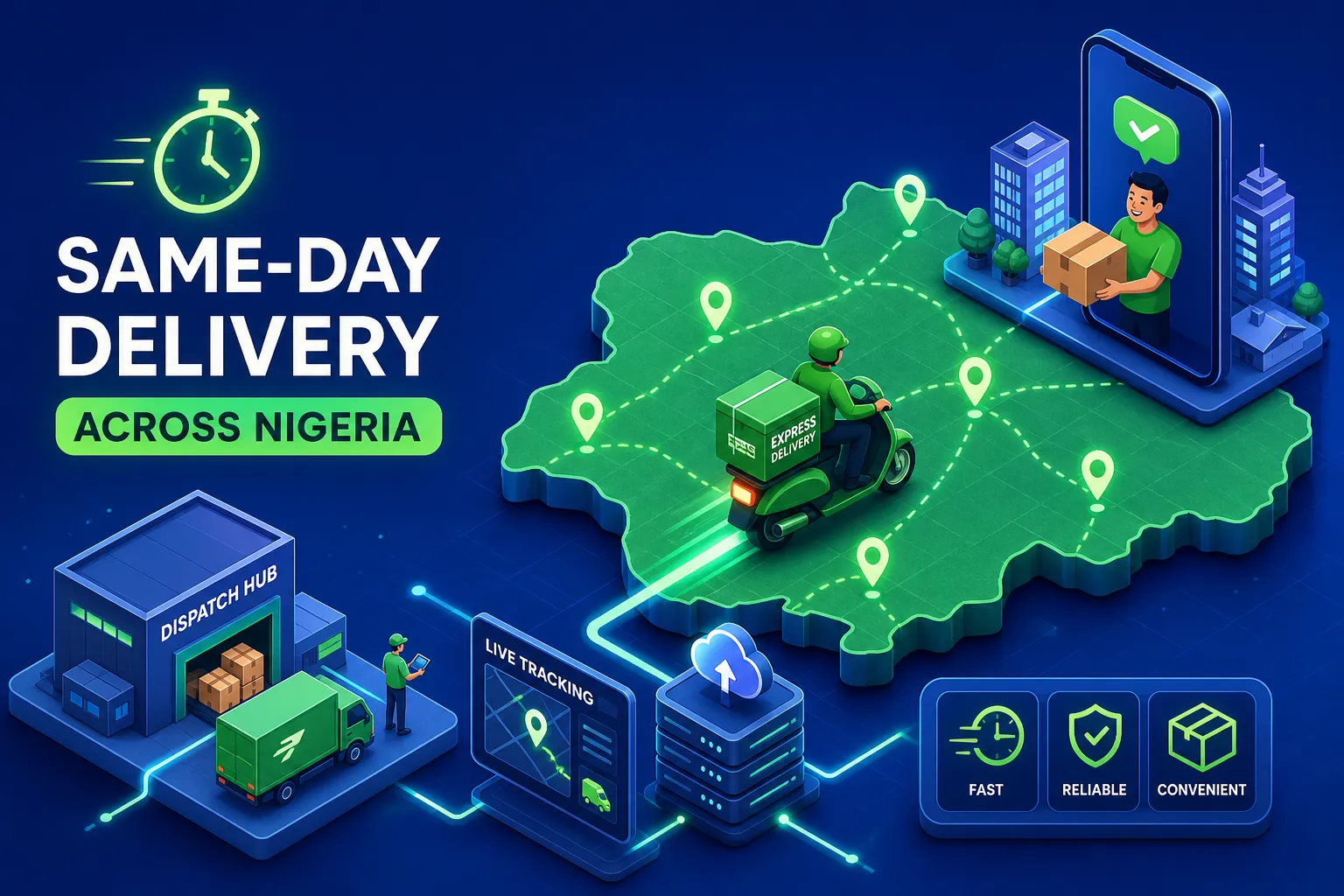
The operational flow looks like this: the customer places an order, you assign it through your fulfilment platform, the nearest storage location receives the dispatch task, a rider picks up from that location and delivers to the customer, COD payment is collected at the door, and funds are credited to your merchant wallet. That sequence is repeatable and systematic. Using dedicated route optimization software for rider paths reduces delivery times and fuel costs, turning a same-day promise into a consistent outcome.
Managing returns and rejections
Returns and rejections are where many sellers lose margin without realising it. A customer refuses delivery, the rider returns the item, and now you have a product out of location, a reversal to process, and potentially a loss on the delivery fee. A good fulfilment partner handles this loop for you: managing the returned stock, processing refunds where applicable, and giving you visibility into rejection rates by city so you can spot patterns early. Selligate says its return-handling workflow is built directly into the platform, which is designed to protect your net margin on COD operations without turning every rejection into a support ticket you manage personally.
Set customer expectations so same-day delivery builds loyalty
The fastest way to turn same-day delivery into a liability is to promise it everywhere and deliver it inconsistently. State your covered cities clearly on your product pages, your social media bio, and in your order confirmation messages. Tell customers the cut-off time upfront. A customer in Abuja who knows “order before 12pm for same-day delivery” will not feel misled if they order at 3pm and receive their item the next morning. The transparency prevents the complaint before it starts.
For cities not yet in your same-day coverage, reframe the message rather than offering an apology. Instead of saying you cannot deliver same day in Kano, say: “We currently dispatch same-day in Lagos, Abuja, and Port Harcourt, with Kano and Ibadan coming soon.” That keeps the narrative growth-oriented and honest at the same time. It tells the customer where you are headed, not just where you fall short today.
The model that makes this all click
Same-day delivery across Nigeria is an inventory position problem, not a courier speed problem. Sellers who solve it are not relying on magic logistics partners with faster bikes. They pre-position stock in their top cities, plug into a fulfilment network with nationwide coverage, and set up a systematic dispatch flow with a clear cut-off time and reliable remittance. That is the full model, and it is achievable for any Nigerian online seller willing to stop dispatching everything from one location.
Selligate E-commerce Fulfillments was designed around exactly this infrastructure: multiple storage locations nationwide, same-day dispatch once an order is assigned, COD collection at the door, and automatic wallet crediting, all managed through one app. Whether you sell fashion on Instagram or gadgets through Facebook ads, the operational challenge is the same. Your stock needs to live closer to your customers.
If you are still asking how can I offer same-day delivery to customers across Nigeria and dispatching from a single location, the answer is not a new courier. Consider a dedicated fulfilment network like Selligate E-commerce Fulfillments, verify their coverage and service-level agreements for your key cities, ship your stock into the network, and build the infrastructure that makes same-day delivery a consistent promise rather than an occasional lucky outcome.