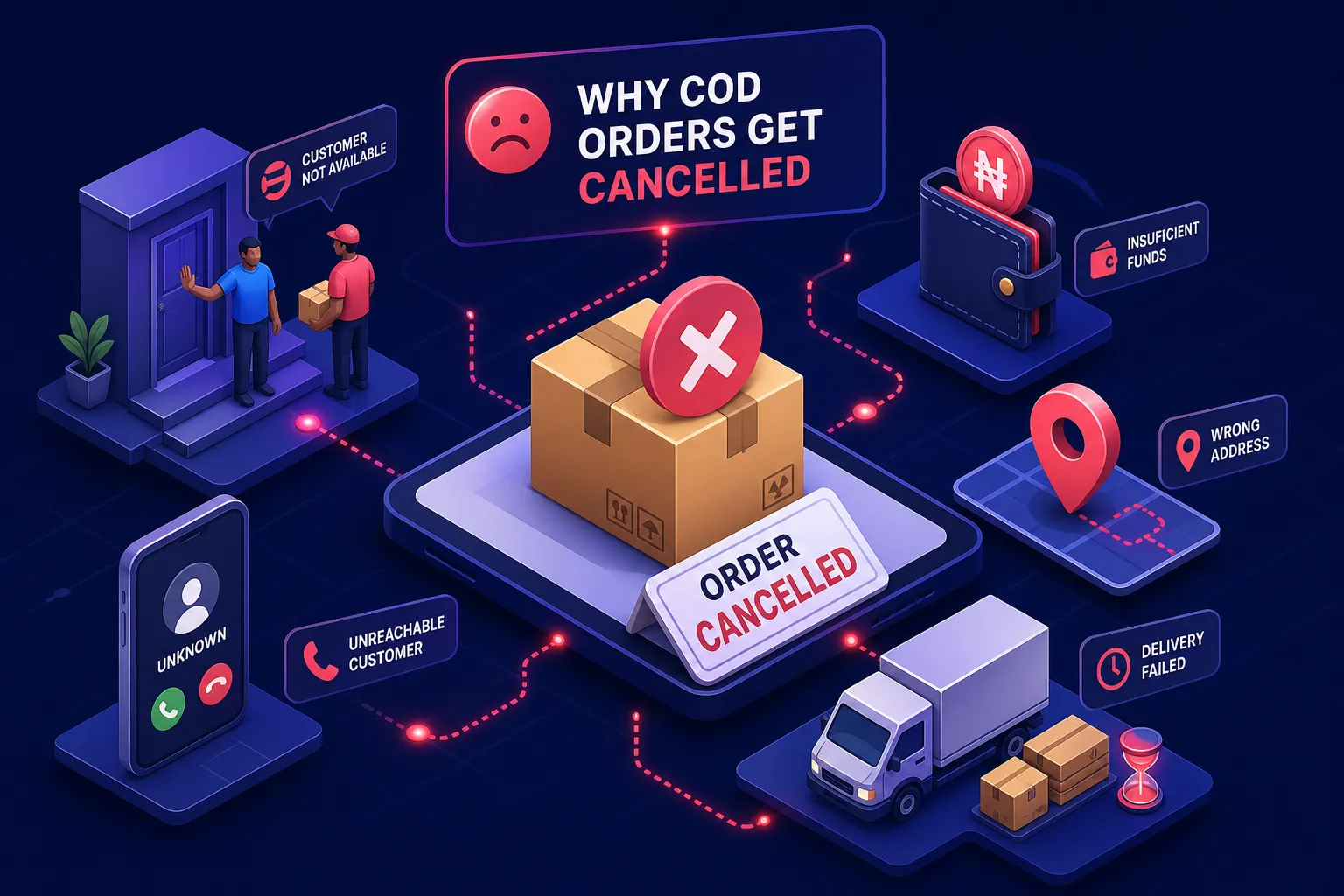
What causes high pay on delivery cancellations for Nigerian sellers? Picture this. A seller runs a Facebook campaign for a week. The orders come in, the DMs are buzzing, and by Friday it looks like a strong month ahead. Then the delivery reports start coming in. By Sunday evening, a significant share of those orders have been refused at the door. The delivery fees are gone. The inventory is back in storage. The margin is destroyed. Many sellers in this situation assume it was bad luck, a bad week, or bad customers. It was none of those things.
High pay-on-delivery cancellation rates are not random. They follow a pattern, and every pattern has specific causes. The sellers who are actually cutting their refusal rates are not working harder. They are treating every cancellation as a diagnostic signal rather than noise, tracing it back to its root cause, and fixing that cause specifically. This article breaks down exactly what drives high POD cancellations for Nigerian sellers and what to do about each one.
The true cost of a cancelled POD order goes beyond the lost sale
Most sellers track cancellations as a number. That is a mistake. Every refused order carries a chain of expenses that compounds quietly, and until you see the full picture, you will keep underestimating how urgently the problem needs fixing.
When a customer refuses delivery, the seller absorbs the outbound delivery fee, the return logistics fee, and the opportunity cost of a rider who could have completed a paying delivery instead. Depending on the delivery company and the city, these costs can add up significantly per failed delivery, and multiply that across 30 to 40 refusals a month, and the numbers become alarming.
Beyond the direct fees, there is inventory tied up in transit, delayed restocking for customers who would have actually paid, and a quietly deteriorating relationship with your logistics partner. High return-to-origin rates can affect your standing with courier partners and may reduce service priority over time. Your cancellation rate is costing you future capacity, not just today’s margin. It is a compounding problem disguised as a one-time loss.
What causes high POD cancellations: buyer psychology
This is the root cause most sellers misread. They assume the customer changed their mind randomly. What actually happens is that pay-on-delivery creates a specific psychological structure that makes cancellation almost rational from the buyer’s perspective, and understanding that structure is the first step to reducing it.
When a customer places a POD order, they commit nothing. No money leaves their account. No card is charged. The psychological cost of ordering is near zero, which makes impulse decisions extremely easy to make and just as easy to abandon. By the time the delivery agent calls, the excitement from clicking “order” has faded. The customer is now making a fresh decision with less motivation and more scrutiny.
Pay-on-delivery was designed to address that distrust, but it also creates a group of buyers who remain suspicious even at the point of delivery. They inspect, they hesitate, and sometimes they refuse on instinct rather than on genuine grounds.
Then there is the financial reality. A customer orders on a Tuesday when they have cash available. By Thursday, when the rider arrives, rent has been paid or an emergency has come up. The money they set aside for the product is gone. This is not fraud. It is the cash-flow unpredictability of a market where most buyers do not use credit, and where delivery windows of 48 to 72 hours give circumstances enough time to change entirely.
How delivery timing quietly destroys order intent
The longer the gap between when a customer orders and when the product arrives, the higher the cancellation risk. This is buyer psychology operating on a predictable timeline, and most traditional logistics models in Nigeria extend exactly the kind of delay that kills intent.
Customer intent peaks at the moment of ordering and drops sharply with time. A customer excited enough to order on Monday morning is a different person by Wednesday evening. They have had time to reconsider the price, find a cheaper alternative, or simply move on. Every additional day of delay increases the likelihood of cancellation. Industry data on cart abandonment, including research from the Baymard Institute, consistently identifies slow delivery as one of the top reasons shoppers abandon purchases, and that only captures the people who quit before ordering. Market reports such as the Nigeria COD market outlook confirm the scale and persistence of cash-on-delivery behaviour across the country. The ones who quit at the door are harder to measure but no less costly.
One of the structural reasons same-day delivery reduces pay-on-delivery cancellations is that it collapses the gap between intent and fulfilment. Merchants who store inventory close to their customers, rather than dispatching from a single warehouse across states, can deliver within hours of an order being placed. Selligate E-commerce Fulfillments is built around this model, with distribution points spread across Nigeria so that orders can be assigned and delivered the same day, before buyer intent has time to decay.
When your product listing sets up a refusal before delivery starts
A significant share of POD cancellations happen because the customer opens the door, inspects the item, and realises it is not what they were expecting. The delivery agent did nothing wrong. The product is technically what was ordered. But the gap between the listing and the reality was wide enough to cause a refusal.
Social commerce in Nigeria, particularly selling on Facebook and Instagram, runs heavily on aspirational creative. Sellers use flattering images with studio lighting and write product descriptions that prioritise excitement over accuracy. A pair of shoes that looks premium in the ad can feel cheap in person. A skincare product described as “large size” can turn out to be a 30ml bottle. Each of these gaps is a cancellation waiting at the door.
Sellers who tighten their product descriptions, using accurate dimensions, unedited photos, clear material descriptions, and honest sizing guides, see lower cancellation rates because the customer’s expectations are already aligned with reality. There is no disappointment at the door. More accurate listings also tend to attract buyers with stronger purchase intent, which further reduces impulsive, low-commitment orders. Honesty is not just ethical here. It is a practical conversion strategy that directly affects your refusal rate.
Unverified addresses, ghost buyers, and the order confirmation gap
Not every cancellation is a changed mind or a disappointed customer. A meaningful portion of POD refusals in Nigeria never had a genuine buyer behind them at all. They are ghost orders: addresses that do not exist, phone numbers that ring out indefinitely, or buyers who placed an order with no real intention of completing the transaction.
Nigeria’s addressing infrastructure is inconsistent across most cities and virtually nonexistent in many residential areas. Buyers frequently give approximate locations (“near the church on the express”) that delivery agents cannot reliably find. When the rider cannot locate the address and the customer is unreachable, the order fails. The seller pays the cost. Operators in the Nigerian fulfilment space consistently report that address validation before dispatch, confirming location details before orders leave the warehouse, eliminates a substantial share of delivery failures that would otherwise result in COD refusal. The exact figure varies by category and city, but the impact is material enough to make it a standard practice among serious sellers.
Calling or sending a WhatsApp message to confirm an order immediately after placement is one of the highest-impact tactics a Nigerian seller can implement today. It filters ghost buyers who never answer, catches customers who ordered accidentally, and confirms delivery details while the order is still fresh. WhatsApp confirmation works particularly well in the Nigerian market because message open rates are high, well above those of cold calls, which makes it easier to actually reach buyers before dispatch. The key is timing: contacting a customer within 30 minutes of order placement consistently yields far higher response rates than waiting several hours. Treat non-responders as unconfirmed orders rather than sending a rider into the unknown.
How to reduce pay-on-delivery cancellations for Nigerian sellers
Knowing the causes is half the job. The other half is knowing which fixes to attempt first. The root causes above fall into two categories: seller-side behaviours you can change immediately, and structural logistics factors that require a different fulfilment setup to solve properly.
Start with what you can change this week. Confirm every order before dispatch, by call or WhatsApp, and treat non-responders as unconfirmed. Audit your product listings for any gap between what your ad creative promises and what the actual product delivers. Offer a small incentive, such as free delivery or a modest discount, to customers willing to pay via transfer upfront. Customers who pay before delivery are far less likely to cancel, and even a small shift in your payment mix has a measurable impact on your overall refusal rate.
Some causes of high pay-on-delivery cancellations cannot be solved by changing a product description or adding a confirmation step. Slow delivery windows require pre-positioned inventory. Cash handling reliability requires vetted delivery agents. Real-time visibility into pending and cancelled orders requires proper fulfilment technology. Sellers who have hit a ceiling with their current logistics setup, especially those expanding beyond Lagos to Abuja, Port Harcourt, Kano, or Ibadan, often find that a dedicated fulfilment partner removes the structural friction that no tactical tweak can fix.
Sellers who have worked through the structural layer, pre-positioned stock, verified delivery agents, and real-time order visibility, report the most consistent reductions in their COD refusal rates. Selligate E-commerce Fulfillments was designed specifically around these requirements: same-day delivery from locally held stock, real-time order tracking, payment remittance to your wallet once delivery is confirmed, and return management handled on your behalf. The service was built by people who ran their own online store and experienced these cancellation causes directly, which shapes how each part of the operation is structured.
The pattern is fixable: reducing POD cancellations starts with the right diagnosis
Pay-on-delivery cancellations are not random and they are not inevitable. The causes are specific: impulse ordering with no financial commitment, trust deficits baked into Nigeria’s e-commerce history, delivery delays that outlast buyer intent, mismatched product descriptions, and unverified addresses. Each one is diagnosable. Each one is fixable.
What causes high pay-on-delivery cancellations for Nigerian sellers is rarely one thing, it is usually a combination of two or three of these factors operating simultaneously. Fix the ones within your direct control immediately. Then audit your logistics setup honestly. If your fulfilment model is structurally producing delays, address failures, and cash-handling gaps, no amount of tweaking your ad copy will close that gap. The sellers reducing their POD cancellation rates in Nigeria are not just working harder. They are working on the right problems, with the right infrastructure behind them.