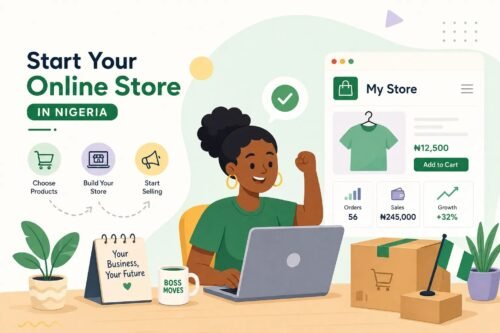
Many aspiring sellers delay starting an online business, not because they lack a good product or the capital to begin, but because they keep waiting: for the perfect website, for a bigger budget, for the moment when everything feels ready. That moment rarely comes.
If you are wondering what is the easiest way to set up an ecommerce business in Nigeria, the short answer is: start smaller than you think you need to. The tools are available, the customers are ready, and much of the infrastructure, including fulfilment partners who handle warehousing, delivery, and cash collection on your behalf, is already in place. You do not have to figure out all of it yourself before you launch.
What follows is a grounded, step-by-step guide for first-time sellers. Seven steps. No unnecessary complexity. By the end, you will know exactly what to do first, second, and third, and nothing in this guide requires a large budget or a technical background to execute.
1. Decide what you’ll sell before anything else
How to pick a product niche that actually moves in Nigeria
This is the most important decision you will make, and it deserves more than a few minutes of thought. Strong product categories for Nigerian e-commerce sellers include phone accessories, fashion and clothing, beauty and skincare, baby products, health supplements, and small home appliances. These categories move consistently because they solve everyday problems for a broad audience.
Before committing to a niche, spend an hour on Facebook Marketplace, Jumia, and Instagram. Look at what people are already buying and what sellers are already running ads for. You want demand that already exists, not demand you have to create. Start narrow: one category, one target customer. A shop that sells “everything” often converts far worse than one that sells specifically to new mothers or gadget enthusiasts in their twenties, a principle consistent with e-commerce best practice worldwide.
Where to source your first products without importing
Local wholesalers and manufacturers are the right starting point for most first-time sellers. You get faster restocking, you can inspect quality before committing, and you avoid customs delays entirely. Typical margins from local wholesale sit between 20% and 50%, while buying directly from a local manufacturer can push that to 30% to 70%, especially once you negotiate on volume.
Dropshipping is worth mentioning here, but only as a testing tool. If you want to validate whether a product sells before spending money on stock, dropshipping reduces your upfront risk. The margins are usually thin, around 10% to 30% net, and you hand over control of the customer experience to a third party. Use it to test, not to build a long-term business.
2. Choose where customers will find you
Easiest Way to Start Ecommerce in Nigeria: Social Channels First
For most Nigerian sellers starting out, social commerce is the right first channel. There are no hosting fees, no technical setup, and the audience is already there. You create a business profile, post product photos with honest descriptions, and take orders through DMs or a simple Google Form.
Many successful Nigerian e-commerce businesses have started exactly this way. Instagram and Facebook are where Nigerian buyers discover new products, and the barrier to entry is low. Set up your profile properly: a clear business name, a short bio that explains exactly what you sell, and a consistent look across your product photos. Good natural lighting is widely recommended over heavy filtering, buyers respond to clarity over polish.
When it makes sense to build your own online store
A standalone website gives you more control, more credibility, and the ability to run more sophisticated ads. Shopify’s Basic plan runs at around $39 per month (billed in USD), while WooCommerce is open-source and requires separate hosting, costs vary by provider and traffic levels. Neither is where you need to start on day one.
Build a website once you are making consistent sales through a social channel. At that point, the monthly cost is easy to justify, and you will know your customers well enough to build a store that actually serves them. Starting with a website before you have validated your product is one of the more common ways to waste time and money before earning your first sale.
3. How to Set Up an Ecommerce Business in Nigeria: Register and Accept Payments
CAC registration: what it costs and what you actually need
Many beginners skip business registration and run into problems later when they try to open a business bank account, run paid ads, or access payment gateways properly. A Business Name registration through the CAC portal costs roughly ₦11,000 to ₦12,000 if you complete it yourself. You will need a valid ID (NIN, passport, or driver’s licence), a passport photograph, your business address, and a short description of what your business does. Check the CAC website directly for the current fee schedule, as charges are subject to change.
The process runs entirely online. You reserve a name, create a CAC account, fill in your business details, upload your documents, pay through the portal, and download your certificate once it is approved. Processing typically takes two to seven working days. A registered business name is sufficient for most small online sellers starting out; you do not need to incorporate a limited company immediately.
Setting up a payment gateway that works from day one
Paystack is a strong recommendation for Nigerian sellers. It integrates with most platforms, charges a transparent 1.5% plus ₦100 per local transaction (capped at ₦2,000), and settles funds to your bank account by the next business day, verify the current rates on the Paystack pricing page before you launch. If you are selling via social media without a website, a Paystack payment link handles checkout entirely. You create the link in your Paystack dashboard, share it in DMs or your Instagram bio, and your customers pay by card, bank transfer, or USSD.
Flutterwave is a reasonable alternative if you plan to accept multicurrency payments or sell to customers across multiple African countries. Each platform has its own fee structure and settlement terms, so compare both against your specific use case. For sellers focused on Nigeria, Paystack is generally the simpler starting point.
4. Handle delivery without building a logistics operation
Why Nigerian shoppers prefer COD and what that means for your business
Most Nigerian online buyers still choose pay-on-delivery. The reason is straightforward: trust in prepaid online payments remains relatively low, and customers feel safer paying when the product arrives. This is not a problem that will disappear soon, and it has real implications for how you structure your delivery process.
Managing COD manually is where most new sellers hit their first serious wall. Using informal dispatch riders means chasing remittances, absorbing rejection rates, industry estimates place Nigerian COD rejection rates between 15% and 30%, and dealing with lost or returned packages without a clear system. It is chaotic, and it eats into margins faster than almost anything else in the business.
How Selligate takes the logistics problem off your plate from day one
Selligate E-commerce Fulfillments was built to address this problem. It is not a generic courier service. It is a full fulfilment partner designed around the realities of Nigerian e-commerce, covering warehousing, last-mile delivery, and COD remittance under one roof.
The model works as follows: you ship your products in bulk to a Selligate distribution point, with locations across Lagos, Abuja, Port Harcourt, Kano, Ibadan, and other cities nationwide. When an order comes in, you assign it through the Selligate app. The order is dispatched to the customer, payment is collected at the door, and the funds are credited to your Selligate wallet. Real-time order tracking shows you delivered, pending, and cancelled orders at a glance. Returns and rejections are managed on your behalf, reducing the back-and-forth that typically derails new sellers. For anyone looking to set up an ecommerce business in Nigeria without building a logistics operation from scratch, this kind of fulfilment partnership is worth evaluating closely. Compare coverage, fees, and service-level terms against your own volume and geography before committing.
5. List your products and launch your first campaign
Writing product listings that make customers want to buy
A strong product listing has three parts: a clear, benefit-focused product name; an honest description that tells the buyer what it is, who it is for, and why they need it; and clean product photos taken in natural light. On Instagram and Facebook especially, buyers make decisions within seconds. The first image and the first line of your caption carry most of the weight, so they need to communicate the product clearly and immediately.
Avoid vague descriptions and stock images wherever possible. Show the product in use, against a clean background, and from multiple angles if you can manage it. Buyers who cannot easily visualise what they are getting either do not buy, or worse, buy and then return.
Your first 10 orders: how to handle them without panic
Expect some slow days, some returns, and some customers who ask questions you did not anticipate. That is completely normal. Keep a simple spreadsheet to record orders, customer names, delivery addresses, and payment status. Respond to messages promptly, even if the answer is just to confirm receipt and provide an update on delivery timing.
Treat your first ten orders as a learning exercise rather than a measure of the business’s potential. If you are using a fulfilment partner, your order dashboard should already be handling the tracking side. Focus your attention on understanding what customers respond to and what questions come up repeatedly.
6. What most beginners get wrong after they launch
Pricing your products to survive, not just to sell
Underpricing is one of the most common early mistakes. It feels like a sensible way to attract your first customers, but once you factor in fulfilment costs, marketing spend, payment fees, and the occasional return, a low-priced sale can easily become a sale at no profit. A simple pricing formula helps: sourcing cost plus fulfilment cost plus marketing cost, then add your margin on top. A sale that earns you nothing is not a win.
Be honest with yourself about what the numbers look like before you publish your first price. It is far easier to launch at a profitable price and offer a limited-time promotion than to raise prices later after customers have already formed an expectation.
Staying focused when everything tells you to expand
After your first few sales, the temptation to add new products, try new platforms, and run bigger ad campaigns is strong. Resist it. The businesses that build something real in Nigerian e-commerce are rarely the ones that scaled fastest. They are the ones that got one product, one channel, and one fulfilment process working consistently before adding anything else.
One product, one channel, and one reliable fulfilment partner, worked consistently, is what builds a sustainable online business in Nigeria. Building an ecommerce business in Nigeria does not mean doing everything at once; it means doing one thing well first, confirming it works, and then building from there.
The first step is the most important one
So, what is the easiest way to set up an e-commerce business in Nigeria? Remove unnecessary steps, start on the channel with the lowest barrier to entry, and bring in a fulfillment partner early so delivery and payment collection don’t become bottlenecks. The steps in this guide are clear. The tools are available. Fulfillment infrastructure, including partners like Selligate E-commerce Fulfillments who specialize in warehousing, last-mile delivery, and COD remittance, exists across the country.
Pick a product. Pick a channel. Register your business name and set up your payment gateway. Identify a fulfilment partner, evaluate their coverage and terms, and place your first stock. Then assign your first order and learn from what follows.
The biggest thing standing between you and your first online sale is simply the decision to start. That part is yours.