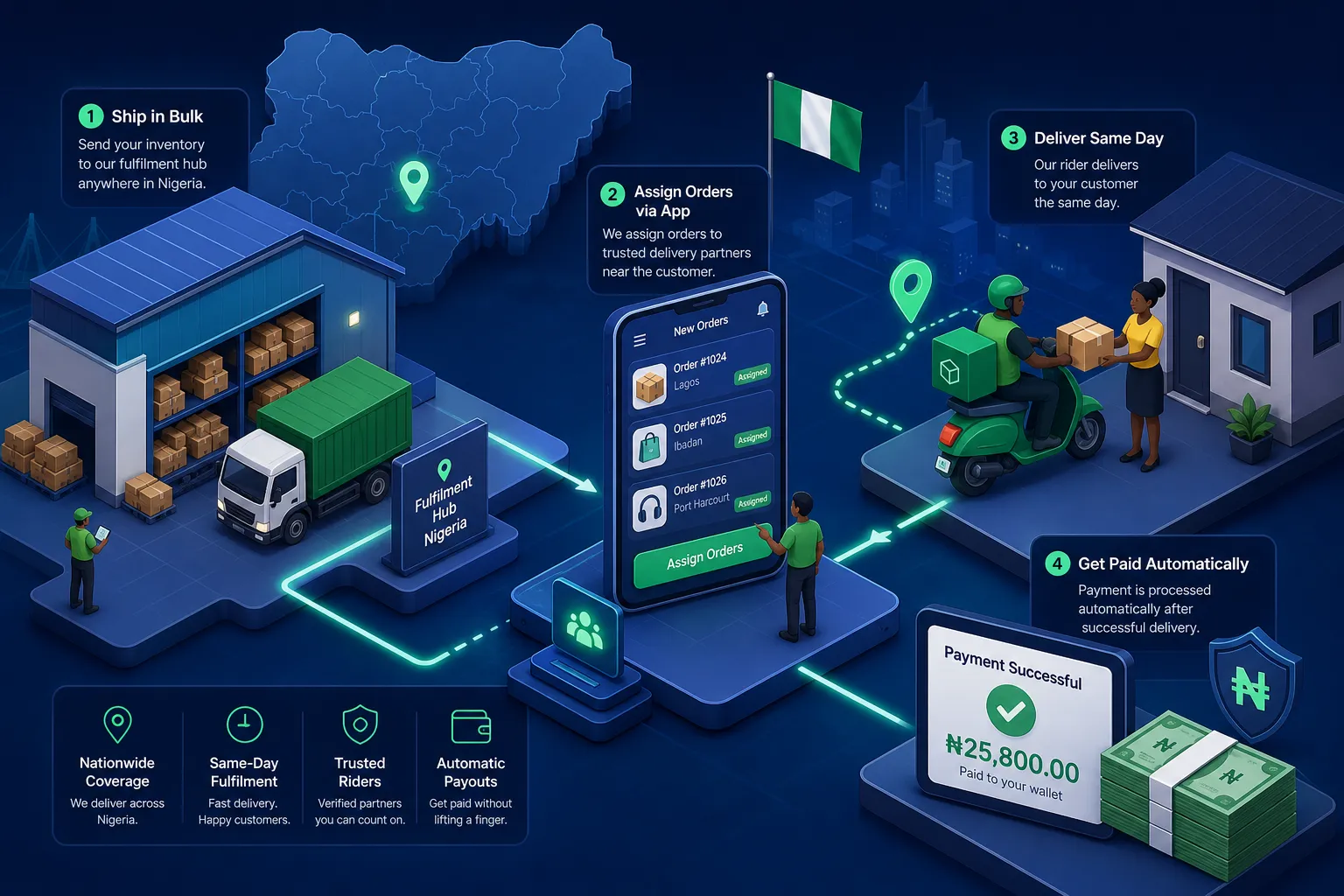
How does Selligate help you achieve same day delivery of your products and pay you same day in Nigeria? The short answer: by storing your stock near your customers before any order is placed, then collecting payment at the door and crediting your wallet the same evening. This article breaks down exactly how that works, step by step, so you can decide whether it fits how your business operates.
You run a Facebook ad, orders start rolling in, and for a moment it feels like everything is working. You hand the packages to a courier, and then the waiting begins. The customer’s phone rings out. The product comes back three days later. Your money is somewhere in transit between a rider and your bank account, and you are not entirely sure when it will arrive. If you have sold physical products online in Nigeria, this is not a horror story, it is a Tuesday.
Selligate E-commerce Fulfillments was built specifically to close both of those gaps at once: same-day delivery and automatic payment settlement. Not one or the other. Both, in a single workflow.
The two problems slowing down most Nigerian online sellers
Why fast delivery is harder than it looks
Many Nigerian online sellers store their products in one city, usually Lagos, while their customers are spread across multiple states. When an order comes in from Abuja or Owerri, the product has to travel hundreds of kilometres through a transport or courier service before it reaches the customer. That often takes multiple days. By that point, the customer has moved on, stopped picking up calls, or simply ordered the same item from someone who could deliver faster.
This is the mechanics behind Nigeria’s well-known COD rejection problem. It is not always bad faith on the customer’s part. Distance and time genuinely erode purchase intent. The longer the gap between “I want this” and “it is at my door,” the more likely the customer is to cancel, reject, or become unreachable. Every delayed delivery is a rejection waiting to happen. For context on how technology is shifting logistics and why local speed matters, see this Guardian piece on how technology is changing the face of e‑commerce logistics.
The cash remittance gap that drains working capital
Even when delivery succeeds, there is a second problem waiting. Regular couriers and dispatch services collect payment at the customer’s door and then hold that cash for days, sometimes weeks, before remitting it to the seller. For a growing online store processing 50 to 100 orders a week, this creates a real cash flow crisis: you need to restock, but your money is locked inside someone else’s float.
These two problems compound each other. Slow delivery raises rejections, which means less cash coming in. Delayed remittance means the cash that does come in arrives too late to fuel the next purchase cycle. Selligate’s entire model is a direct response to both, and the way it is structured makes same-day COD fulfilment in Nigeria genuinely repeatable.
How Selligate enables same-day delivery and payment in Nigeria
Step 1: Ship your inventory to a distribution point near your customer
Instead of moving products one order at a time across long distances, merchants ship inventory in bulk to Selligate’s distribution points across 35+ cities and towns in Nigeria. Your stock sits in secure warehousing at those locations, ready to be dispatched the moment an order comes in. This is the foundational difference between Selligate and a regular courier: your product is already near the customer before the order even exists.
This pre-positioning model is what makes Selligate same-day delivery possible at scale. There is no cross-country movement to coordinate per order. The product is already in Abuja when the Abuja customer clicks “buy.”
Step 2: Assign the order through the Selligate merchant app
When a customer places an order, you log into the Selligate application, select the product from your stored inventory at the relevant distribution point, and assign the delivery. Selligate’s on-ground fulfilment agents in that city pick, pack, and dispatch the item immediately. You do not need to be in the same city, make any calls, or chase a rider.
The application also gives you a real-time view of delivered, pending, and canceled orders, so you always know exactly what is happening across all locations you operate. If you prefer a quick walkthrough, watch a short video overview that highlights the core application features. Note that the new version of the application may look different at the time you are reading this article, but the model and flow remain the same.
Step 3: Your customer receives the order the same day
Once the order is assigned, Selligate’s agent delivers to the customer within the same day, and within three hours in major cities like Lagos, Abuja, and Onitsha, based on Selligate’s published coverage specifications. The delivery agent collects payment at the door in cash, by card, or via mobile transfer. Because the product is already at a local distribution point and not sitting in a warehouse 800 kilometres away, that timeline is consistently achievable. Learn more about what cash‑on‑delivery is and how it works if you want a primer on common COD flows.
A real example: Lagos fashion seller, Abuja customer, same-day delivery
The situation before Selligate
Chioma runs an online womenswear brand from Lagos and sells across Nigeria through Instagram ads. When an Abuja customer orders a dress, Chioma ships it via a transport service. The package takes two to three days to arrive. By then, the customer has ordered something similar elsewhere, the dress comes back, and Chioma loses both the delivery fee and the sale. This scenario plays out countless times daily across Nigerian e-commerce. For more background on COD behaviour and customer tendencies, see this short guide to cash‑on‑delivery.
What the same order looks like through Selligate
With Selligate, Chioma ships a batch of her bestselling dresses to Selligate’s Abuja distribution point in advance. When the customer places an order on Tuesday morning, Chioma opens the Selligate app, assigns the order, and Selligate’s Abuja agent delivers the dress to the customer before 6pm the same day. The agent collects pay-on-delivery at the door (see the pay‑on‑delivery FAQ for common questions).
By the time Chioma checks her phone that evening, the funds are already reflected in her Selligate wallet. No follow-up calls. No chasing riders. No waiting three days to find out the order was rejected. This is what same-day COD fulfilment looks like when it is engineered properly.
How payment collection and wallet settlement work
What happens at the customer’s door
Selligate’s fulfilment agent collects payment directly from the customer upon delivery. This removes you, the seller, from the collection process entirely. There is no risk of the rider going unreachable or holding cash longer than agreed. Selligate’s distributor accountability structure includes remittance obligations and contractual penalty clauses that protect merchants.
The customer pays once, at the door, through whichever payment method works for them. That payment moves directly into the settlement chain, not into an informal arrangement between you and a freelance dispatch rider. If you want deeper reading on settlement mechanics used in modern platforms, review resources on how merchant settlements are processed and a practical payment settlement process explanation.
Same-day payment settlement via Selligate wallet
After payment is collected, the amount is automatically credited to your Selligate wallet, giving you immediate visibility of your balance. You can initiate a withdrawal to your bank account at any time. Under standard remittance terms, funds are transferred to your bank within minutes of initiating the withdrawal. Your wallet balance is updated as soon as payment is confirmed, so you are never left guessing where your money is. For journalism on payment innovations that are reshaping e‑commerce finance, read this Vanguard report on payment solutions.
Selligate does not charge a commission on payment collection. The service earns through the delivery fee alone. What lands in your wallet is the full amount the customer paid for your product, net of the delivery fee.
Coverage, delivery fees and the pay-only-if-delivered policy
Where Selligate currently operates in Nigeria
Selligate’s same-day delivery network spans 35+ cities and towns across Nigeria. Covered locations include:
Lagos, Abuja, Port Harcourt, Kano, Ibadan, Enugu, Owerri, Warri, Uyo, Calabar, Ilorin, Onitsha, Benin City, Aba, Jos, Asaba, Abeokuta, and additional towns across covered states.
Same-day delivery applies within each covered city. For states where the main city serves as a hub, such as Onitsha for Anambra, Selligate also delivers to other towns within the state via waybill. This gives you reach well beyond the top commercial cities. Confirm current coverage on Selligate’s official coverage map, as new locations are added regularly. If you ship items that have shipping restrictions, review resources on e‑commerce restricted shipping and compliance as well as platform lists like the Shopify prohibited items and Google’s merchant product restrictions.
What delivery costs and what happens when an order is rejected
The default delivery fee is ₦5,000. If a particular delivery requires additional cost due to distance, Selligate communicates this upfront before you commit. More importantly, Selligate charges the full fee only if the delivery is successful. If a customer rejects an order without a valid reason or is unavailable after the rider has visited, you pay 50% of the delivery fee to cover the rider’s visit, not the full amount.
For new merchants who start shipping early, there is a promotional rate of ₦2,000 per delivery (50% off) for deliveries within Lagos, Abuja, Port Harcourt, and Kaduna, and it is applicable for two months. This promotion is time-limited and slot-dependent, so it is worth acting on quickly. Check the merchant dashboard for current pricing and promotion availability, as rates may be updated.
How to get started with Selligate
The onboarding steps from registration to first delivery
The onboarding process is straightforward. You register on the Selligate platform, add your products and set your prices, and select the distribution point locations that match your customer base. Then you ship your inventory in bulk to those points. Once your stock is in place, you start assigning orders through the app as they come in. For a community update from Selligate on merchant onboarding and SME support, see the Selligate LinkedIn post.
No logistics background is required. The app handles tracking, order history, sales records, and withdrawal management from one dashboard. Selligate has onboarded over 2000 merchants and more than 200 active distributors, figures cited from Selligate’s own merchant data. The process is designed for sellers who want to focus on marketing and product, not on coordinating deliveries across cities they have never visited. You can also watch a customer testimonial video here.
Why Selligate’s model outperforms a regular courier for Nigerian sellers
A regular courier collects your parcel, moves it across cities, and returns cash days later, if it arrives at all. Even if the delivery is not completed, you will pay the delivery fee in advance, and if the delivery fails, there will be no refund. The entire model depends on your product starting its journey from wherever you store it, which typically means slow delivery, high rejection rates, and delayed remittance. Selligate flips this entirely: your stock is pre-positioned near the customer, delivery happens the same day, payment is collected on the spot, and your wallet is credited the same evening.
For Nigerian sellers processing orders from Facebook, Instagram, or their own websites, this distinction determines whether your business scales or stalls. If your fulfilment model cannot keep pace with your marketing, growth will always hit a ceiling. That ceiling is what Selligate was built to push through.
Start your merchant registration today
Nigeria’s e-commerce market has two persistent problems: slow delivery kills conversion, and delayed remittance kills cash flow. Selligate’s pre-positioned fulfilment model tackles both in a single workflow. Whether you sell fashion, gadgets, health products, or home goods, the approach is the same, stock pre-positioned close to the customer, Selligate same-day delivery, and payment settled in your wallet the same evening.
If you have been losing sales to slow couriers or losing sleep over delayed remittances, the infrastructure to fix both problems already exists. Register as a merchant on Selligate E-commerce Fulfillments, ship your first batch of inventory to a distribution point near your customers, and run your first orders through the system. Give it one week and watch your rejection rate drop.