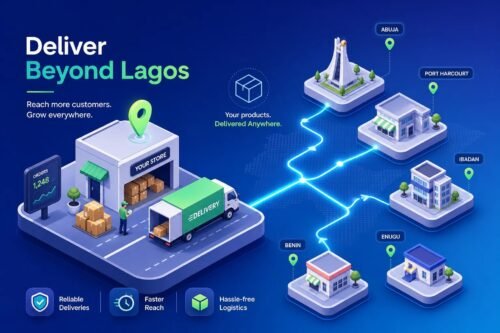
Picture this: you’ve just built a steady rhythm selling health supplements to customers across Lagos. Then a notification pops up: an order from Abuja. Then another from Kano. The excitement is real, for about ten minutes. Then the questions start. Which logistics company do you trust for a three-day journey? How much do you charge the customer? What happens if they reject the package and you are 700 kilometers away?
If you have been asking yourself, “How do I start delivering my products to customers outside Lagos, Nigeria?” you are not alone. Many sellers handle this moment in one of two ways: they turn down out-of-state orders entirely, or they attempt it without a plan and lose money. Neither approach makes sense when the rest of Nigeria represents a customer base that dwarfs Lagos many times over. The problem isn’t that interstate delivery is impossible. The problem is that most sellers attempt it without a proper system.
This guide walks you through every step of that system: choosing your delivery partner, calculating honest delivery costs, packing products correctly, managing stock across states, and building a returns process that keeps customers coming back rather than filing complaints. How to deliver your products to customers outside Lagos?
Why delivering outside Lagos trips up most sellers
The frustration most sellers feel when interstate deliveries go wrong isn’t a failure of effort. It’s a failure of expectation. Local Lagos delivery has trained merchants to think of logistics as a simple, affordable, same-day operation. Interstate delivery is a different animal entirely.
The hidden costs that eat your margins on interstate orders
Sellers consistently underestimate the true cost of shipping beyond Lagos. The quoted logistics company rate is only the starting point. Add terminal fees, home-delivery surcharges per parcel, failed-attempt fees when the customer isn’t available, and return shipping when the package bounces back. The realistic cost range for interstate delivery sits between ₦7,000 and ₦15,000 per order, and what pushes an order toward the higher end is a combination of distance, home delivery, and any failed attempt that triggers a re-delivery or return cycle.
Why COD rejections hurt more in unfamiliar markets
A customer in Kano doesn’t know your brand, hasn’t seen your packaging before, and has no relationship with you to fall back on when the order feels uncertain. Industry experience in Nigerian e-commerce puts typical COD rejection rates between 20% and 30% for new or unbranded sellers, and that figure tends to climb when the customer is far from your base. When a Lagos customer rejects an order, your dispatch rider turns around and comes back. When a Kano customer rejects an order, you could be looking at ₦10,000-₦20,000 in wasted two-way shipping costs, based on typical long-route return rates. Interstate COD is structurally riskier than local delivery, and your fulfillment system needs to account for that from the start.
The logistics reliability problem in other states
A logistics company that performs brilliantly in Lagos can fall apart in Calabar or Katsina. Staffing density thins out significantly outside major commercial hubs, road infrastructure varies wildly, and last-mile accountability drops when there’s no strong branch presence to enforce standards. Sellers who ship successfully within Lagos and assume the same delivery company will perform consistently in Plateau or Benue State are routinely disappointed. Understanding this before you choose your delivery partner can help you avoid costly mistakes.
How to start delivering products to customers outside Lagos: Logistics company or fulfillment partner?
The first practical decision you need to make is whether you’re looking for a courier or a fulfilment company. Most sellers treat these as interchangeable, and that confusion is expensive.
What a logistics company service actually does (and what it doesn’t)
A logistics company’s service moves parcels from point A to point B. That is its core function. It doesn’t store your inventory, manage your COD reconciliation, or guarantee same-day delivery in locations where it lacks dense last-mile coverage. GIG Logistics, one of Nigeria’s largest indigenous logistics companies, offers a 24, 48-hour express interstate option and solid nationwide reach. Red Star Express and CourierPlus are strong options for straightforward deliveries and parcels going to well-served state capitals. For sellers with occasional out-of-state orders who don’t need warehousing, these couriers are a sensible starting point.
When a fulfilment partner makes more financial sense
A third-party logistics (3PL) or fulfillment company does considerably more than move parcels. It stores your inventory, handles same-day delivery from pre-positioned stock, collects COD payments on your behalf, and remits funds back to your account. Once your order volume rises or COD rejections start recurring, standard logistics companies become expensive band-aids. You spend money shipping individual orders long distances, absorbing return costs, and chasing payment reconciliation. A fulfillment partner restructures that entire workflow.
The one question that determines which option you need
Ask yourself: do you want to ship parcels, or do you want to fulfil orders? Shipping a parcel is a courier’s job. Fulfilling an order, which involves storage, delivery, COD collection, returns handling, and payment remittance, requires a proper fulfilment partner. Your answer to that question should drive every other decision in this guide.
How to estimate and price your interstate delivery costs
Guessing at delivery pricing is one of the fastest ways to bleed money on interstate orders. You need benchmarks and a pricing structure before you accept your first out-of-state sale.
What drives shipping costs from Lagos to other states
Five factors move the price on any interstate delivery: destination distance, parcel weight and dimensions, service speed (standard versus express), terminal pickup versus home delivery, and failed-delivery risk. Home delivery consistently adds ₦1000 to ₦2,000 above the terminal rate because it involves a separate last-mile trip inside the destination city. A Lagos-to-Ibadan delivery is structurally cheaper than Lagos-to-Port Harcourt because the distance is shorter and road conditions are more manageable. Weight tiers shift costs quickly, so always confirm rates for your specific parcel weight before quoting a customer.
Realistic rate ranges for major Nigerian routes
Based on 2026 market rates from major carriers, small parcels under 2 kg from Lagos run approximately ₦6,000 to ₦9,000 to Abuja and ₦4,000 to ₦12,000 to Kano and Port Harcourt, respectively, and ₦3,500 to ₦8,000 to Ibadan. These are starting points, not guarantees; verify directly with your chosen logistics company before publishing delivery prices, as express services, home-delivery surcharges, and weight overruns can push any route toward the higher end of its range.
How to build delivery pricing so you don’t absorb the cost yourself
Start by calculating your break-even delivery fee for each zone: the point at which the delivery charge covers your courier cost including a buffer for failed attempts. Offering free delivery nationwide sounds appealing but is financially reckless unless your product margin is substantial enough to absorb ₦15,000 in potential two-way shipping costs. A tiered delivery pricing structure by zone is far more sustainable: customers in Ibadan pay one rate, customers in Abuja pay another, and customers in farther states like Kano or Yobe pay a rate that reflects the actual distance and risk.
Packaging and documentation you can’t afford to skip
A frequent cause of interstate delivery damage is sellers packing for a 30-minute Lagos delivery and then sending that same package on a three-day road journey to Port Harcourt. The road between Lagos and Port Harcourt is considerably harder on parcels than a short local run, and your packaging needs to reflect that difference.
How to pack products for interstate road delivery in Nigeria
Use double-walled cartons for anything heavier than 1 kg or fragile. Cushion all four sides, the top, and the bottom with bubble wrap or polystyrene foam. Leave no empty space inside the box; shifting during transit causes most road damage. Seal cartons with pressure-sensitive tape that is at least 5 cm wide, preferably 7.5 cm, applied in an H-pattern across all seams. Apply “Fragile” or “This Side Up” labels where relevant, and always include your recipient’s full name, state, and phone number on the outside of the package. Adding the Local Government Area (LGA) is also recommended for Nigerian interstate deliveries to help the delivery company route accurately at the last mile.
Labelling your packages so they reach the right person
Label-to-document mismatches commonly cause misdirected parcels. The name and address on the outside of your package must match exactly what appears on the waybill. Include the waybill reference number visibly on the package exterior, not just inside the paperwork envelope. A package that arrives at a logistics company hub in Abuja with an unclear or mismatched label may be held until the discrepancy is resolved, and the customer experience suffers badly in the meantime.
Export documents for sellers shipping overseas
For Nigerian sellers shipping to the UK, US, or EU, the minimum documentation set includes a commercial invoice, packing list, bill of lading or air waybill, certificate of origin, and your Nigeria Customs e-NXP export filing. Product-specific certificates, such as phytosanitary certificates, NAFDAC documentation, or FDA registration for US-bound shipments, apply depending on what you’re exporting. International export documentation is a topic that deserves its own dedicated guide; what matters here is that you don’t attempt an international shipment without confirming the full document requirements for your specific product category and destination country.
Managing inventory across multiple states without the chaos
This is the section many sellers never reach because they give up before they get here. It’s also where the real competitive advantage in Nigerian e-commerce sits, so it’s worth pushing through to understand it.
Why holding all your stock in Lagos limits your reach
Every order you fulfil from a single Lagos warehouse pays for the entire distance between you and your customer on every single parcel. A seller based in Ikeja shipping to a customer in Kano pays for roughly 900 kilometres of road freight per order, absorbs the full COD rejection risk on a long delivery window, and delivers a slower, more expensive customer experience than a competitor with stock already in the North. The maths compounds quickly when you consider that longer transit times directly correlate with higher rejection rates.
How pre-positioning inventory changes the maths
When your products are already warehoused in Abuja before the orders arrive, an Abuja customer receives a same-day local delivery instead of a two-day interstate parcel. Delivery costs drop dramatically, customer satisfaction improves, and COD rejection rates fall because customers receive goods faster and with greater confidence. Pre-positioning requires upfront bulk shipping of inventory to fulfilment points, but the per-order cost savings make it one of the highest-return operational investments an e-commerce seller can make.
How Selligate helps you deliver outside Lagos without managing the complexity yourself
This is precisely the model Selligate E-commerce Fulfillments was built around. Selligate operates distribution points across Nigeria, covering major hubs including Lagos, Abuja, Port Harcourt, Kano, and Ibadan, allowing merchants to ship inventory in bulk to multiple locations and then assign individual orders through a single platform. When an order comes in, the merchant assigns it through the app. Selligate’s team at the nearest distribution point handles picking, packing, and local delivery. COD payment is collected at the door, and funds are remitted directly to the merchant’s account. No interstate logistics negotiations per order, no chasing unfamiliar local riders, no waiting weeks for payment reconciliation. The entire fulfillment stack- warehousing, delivery, COD collection, returns handling, and payment remittance- runs through one platform.
Setting up tracking and managing returns professionally
Getting the product to the customer is only part of the job. How you handle visibility and returns determines whether that customer buys from you again.
Giving customers real-time visibility into their orders
Out-of-state customers are more anxious about their orders than Lagos-based ones for an obvious reason: they have no way to follow up easily. Proactively share courier tracking links at the point of dispatch, not when the customer asks. GIG Logistics, Red Star Express, and most major Nigerian couriers provide waybill-based tracking links. If you’re using a fulfilment partner with a tracking dashboard, share order status updates at the key stages: confirmed, shipped, out for delivery, and delivered. A customer who knows exactly where their order is rejects it far less frequently than one left wondering.
How to handle returns from customers in other states
Interstate returns are expensive when they’re unplanned, and they will happen. Build a three-part returns framework before you start selling nationwide. State your return policy clearly before purchase so customers know what to expect. Have a pre-agreed process for defective items, either a pre-paid return waybill, or a direct replacement or refund arrangement. Set a realistic replacement or refund timeline that you can actually honour given the distance involved. Most importantly, build a returns cost buffer into your delivery pricing from day one. A ₦15,000 two-way shipping cost on a rejected ₦8,000 order is not a logistics failure. It’s a pricing failure that was always going to happen.
How do I start delivering my products to customers outside Lagos? Start with one step this week
Delivering your products to customers outside Lagos, Nigeria is not a stretch goal for later. It’s the path from running a local operation to building a nationwide brand. Understand the real cost structure, choose the right delivery partner for your volume, price delivery honestly, pack products for road freight, solve the inventory-positioning problem, and build tracking and returns into your process from day one.
Sellers who want to avoid the complexity of building this infrastructure from scratch should look for fulfillment partners that handle it end-to-end. Selligate E-commerce Fulfillments is worth exploring if you sell physical products on a COD model and want to deliver outside Lagos without managing separate riders, warehouses, and payment collection in states you’ve never visited.
Pick the single most urgent step from this guide and act on it this week, whether that’s requesting your first interstate rate quotes or reviewing your packaging standards. One concrete action now puts you further ahead than another month of planning.