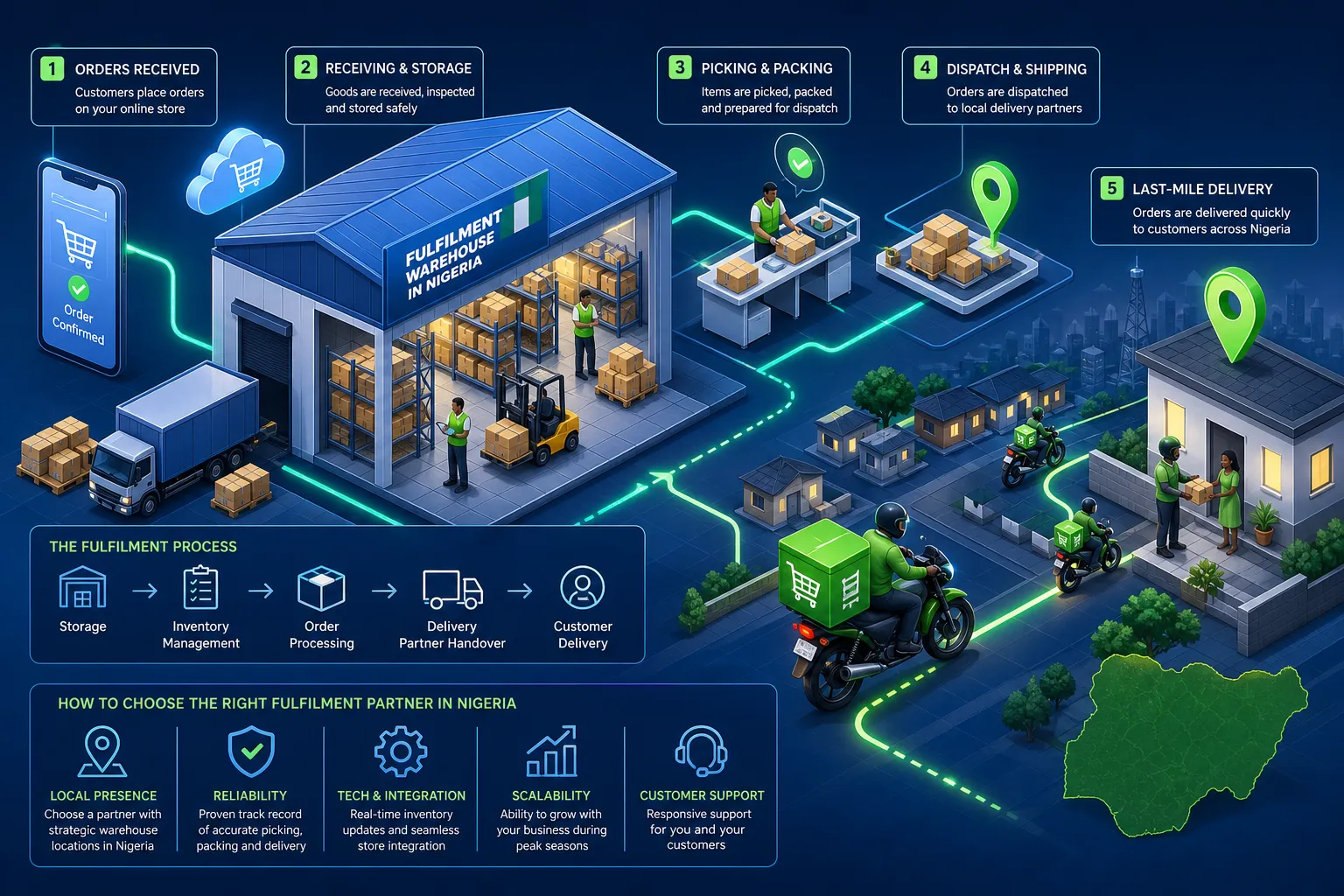
What is ecommerce fulfilment warehousing and how does it work in Nigeria? Picture this: you are running Facebook ads for your online store, orders are coming in daily, and your product reviews are solid. But somewhere between the customer clicking “buy” and your dispatch rider showing up three days later, you are losing sales. Customers reject parcels at the door. Payment can take over a week to reach you. You spend more time chasing logistics than actually growing your business. Sound familiar?
Now flip the scenario. What if your products were already stored near your customers, in a major urban hub like Lagos Island or Abuja, before they even placed an order? What if the moment an order came in, it was picked, packed, and on its way within hours? That is not a fantasy. It is exactly how e-commerce fulfillment warehousing works in Nigeria, and sellers across the country are already using it to operate at a level that informal dispatch arrangements simply cannot match.
Businesses like Selligate E-commerce Fulfillments have built this model from the ground up, operating distributed inventory across multiple locations nationwide and handling everything from storage to same-day delivery and faster payment remittance. By the end of this article, you will understand what ecommerce fulfilment warehousing means in the Nigerian context, how the process works step by step, what it typically costs, and how to choose the right partner for your business.
What is ecommerce fulfilment warehousing and how does it work in Nigeria?
Ecommerce fulfilment warehousing is the practice of storing your inventory inside a third-party warehouse or network of warehouses so that when a customer places an order, the fulfilment partner handles the picking, packing, and delivery, without you touching a single parcel. You are not just renting shelf space; you are outsourcing the entire operational chain from the moment your stock leaves your hands to the moment it reaches your customer’s door.
The distinction between a fulfilment centre and a regular storage facility matters. A regular warehouse simply holds goods. A fulfilment centre is active and process-driven: it receives your stock, manages inventory levels in real time, processes orders as they come in, and dispatches them through a delivery network. It is the difference between parking your products somewhere and putting them to work.
How it differs from sending a courier
A courier picks up a parcel from your doorstep and delivers it. The stock starts with you, which means delivery time depends entirely on where you are relative to the customer. Consider a seller based on Lagos Island trying to reach a buyer in Ikeja, a courier arrangement means the parcel travels from your location outward. A fulfilment partner, by contrast, holds your stock in advance at locations already close to your buyers. When an order comes in, the goods are already positioned for same-day delivery. You never have to be physically involved in the dispatch process at all.
The role of a fulfilment centre in your supply chain
The fulfilment centre sits between your supplier or production point and your end customer. Think of it as the operational backbone bridging manufacturing and last-mile delivery. You produce or procure in bulk; the fulfilment centre receives, stores, and ships to individual buyers on demand. That separation is what allows a single seller to serve customers across multiple cities simultaneously.
The step-by-step ecommerce fulfilment warehousing workflow: from your stock to your customer’s door
The fulfilment cycle has several stages, but your active role as a seller is mostly at the beginning and the end. You ship stock in; you receive payment. Everything in between is handled by the fulfilment partner. For a practical walkthrough of how these operational stages fit together, see this concise ecommerce fulfilment process guide.
Bulk shipping and inventory receiving
You ship your products in bulk to the fulfilment warehouse, not one item at a time per order. On arrival, the warehouse team inspects, counts, and logs each SKU into the inventory management system. Stock is labelled and assigned to a storage bay or bin. That is where your physical involvement ends.
Order assignment and pick-and-pack
When a customer places an order, you assign it through the fulfilment platform’s app or dashboard. The warehouse receives the instruction, a pick list is generated, and the team retrieves the exact item, packs it securely, and prepares it for dispatch. On platforms like Selligate, this can trigger a same-day delivery workflow automatically once an order is assigned, no manual intervention required on your end, subject to cut-off times and coverage in that delivery zone.
Last-mile delivery and payment remittance
The packed order moves to a delivery agent for last-mile dispatch. For cash-on-delivery orders, which remain the dominant model in Nigeria, the agent collects payment from the customer at the door. The fulfilment platform then remits that payment to the merchant’s wallet or bank account. Remittance timelines vary by provider: standard practice in Nigeria is commonly 7 to 15 working days, though some platforms offer early or accelerated remittance options. Understanding your partner’s remittance schedule upfront is critical to managing your cash flow.
Why Nigerian online sellers are making the switch to fulfilment warehousing
Cash-on-delivery remains a significant payment channel in Nigerian ecommerce. According to 2023 market data, COD accounted for roughly 70% of online sales in Nigeria, a notable share that reflects the continued low consumer trust in prepaid digital transactions. For sellers, this creates two chronic problems: high rejection rates when delivery takes too long, and delayed remittances when informal dispatch riders are involved.
The COD rejection problem it solves
When delivery takes three to five days, customers change their minds. They go cold on the purchase, find it elsewhere, or simply refuse the parcel at the door. When delivery happens the same day, the customer is still excited about the order. Pre-positioning inventory close to your buyers is one of the most effective ways to reduce COD rejection rates in Nigeria, because it compresses the time between order placement and doorstep delivery from days to hours. Micro-fulfilment approaches, placing stock in urban distribution hubs, have shown particular promise in reducing last-mile risk for Nigerian sellers. Practical guidance on navigating those local delivery challenges is available in resources addressing last-mile delivery challenges in Nigeria.
Selling nationwide without relocating
For a Lagos-based seller who wants to reach customers in Abuja, Port Harcourt, or Kano, fulfilment warehousing removes the logistical and financial barrier of managing cross-state deliveries. Stock sitting in a hub close to those customers enables faster delivery across the fulfilment network, though it is worth noting that same-day delivery is most reliable in major urban centres where infrastructure and provider coverage are strongest. You do not need to open a new office or hire a team in every city; the fulfilment network handles that coverage for you.
In-house logistics vs third-party fulfilment: choosing the right model
There is no single correct answer here. The right model depends on where your business actually is right now, not where you hope it will be in six months. Here are three realistic options, assessed honestly.
When managing it yourself still makes sense
If you process fewer than 20 to 30 orders per day, a common industry rule of thumb, carry a small number of SKUs, and sell primarily within a single city, self-fulfilment can work. You control every touchpoint and avoid third-party fees. The problem is that this model breaks quickly when order volume scales, when customers in other states start buying, or when a single rider calling in sick derails your entire fulfilment day.
When a 3PL fulfilment partner becomes the smarter choice
Once order volumes grow, geography expands, or COD rejection rates start eating into your margins, the real cost of managing logistics yourself typically exceeds the cost of outsourcing it. A third-party logistics (3PL) partner brings infrastructure, technology, and geographic coverage that no individual seller can replicate independently. On-demand warehousing sits between these two options: flexible, volume-based, and useful for sellers testing new markets before committing to a full fulfilment arrangement. It is worth considering if you are expanding to a new state and want to validate demand before shipping a full consignment of stock there. Providers are starting to offer flexible models specifically for Nigeria, for example, see this overview of on-demand warehousing in Nigeria.
What ecommerce fulfilment warehousing typically costs in Nigeria
Most Nigerian fulfilment providers do not publish a public rate card, and that is worth saying plainly. Pricing is customised based on your order volume, number of SKUs, storage duration, and delivery zones. That said, there are standard cost components every seller should understand before requesting a quote, so you are not walking into a conversation blind. For further reading on typical 3PL pricing structures and components, consult a detailed 3PL pricing and rates guide.
The main pricing components to budget for
There are four core components to account for, and understanding each one will tell you your true cost per sale, which is the number that actually matters.
- Storage fees, charged per pallet, bin, or cubic metre per month. Some providers bundle storage into their delivery pricing as a competitive advantage; others charge it separately.
- Pick-and-pack fees, charged per item or per order processed.
- Inbound receiving fees, applied when your bulk shipment arrives at the warehouse.
- Shipping and delivery rates, charged per parcel, based on weight and delivery zone.
How to get a cost estimate that actually means something
Come prepared with three numbers when requesting quotes: your average monthly order volume, the number of active SKUs you stock, and the delivery cities you need covered. This allows providers to give you a quote that reflects actual usage rather than a generic minimum. Always ask for a per-order cost breakdown, not just a monthly retainer figure. A low monthly minimum that hides a high per-order charge is not a bargain.
How to choose the right Nigerian fulfilment partner
Picking a fulfilment partner is not about finding the cheapest option or the one with the nicest website. It is about finding a provider whose operational model actually solves the specific problems you face as a Nigerian ecommerce seller. Four criteria consistently separate strong partners from unreliable ones.
The four criteria that actually matter
Geographic coverage is the first question: how many states and cities can the provider deliver to, and how quickly? A provider with coverage across 10 or more states is materially different from one that operates in Lagos only.
COD handling and remittance speed is the second. How quickly does payment reach your account after a successful delivery? Standard remittance in Nigeria can range from 7 to 15 working days with many providers. A platform that credits your wallet sooner, whether through early remittance or wallet-based settlement, changes your cash flow significantly. Ask for the remittance schedule in writing before you sign anything.
Returns management comes third. What happens when a customer rejects or returns a parcel, and who bears the cost? This is where many fulfilment arrangements fall apart in practice, so get clear answers before you commit.
Platform transparency is the fourth. Can you see real-time order status, delivered, pending, cancelled, all in one dashboard, without calling anyone? Visibility is not a luxury; it is a baseline requirement for running a scaling ecommerce operation.
What a good fulfilment partnership looks like in practice
Selligate E-commerce Fulfillments was built specifically around these pain points. Merchants ship inventory in bulk to distribution points across multiple locations nationwide, assign orders through the Selligate app, and receive payment once delivery is confirmed. Returns and rejections are handled through the platform rather than through a chain of WhatsApp messages, and order status is visible at every stage. Those are the standards worth holding every potential fulfilment partner to before you commit.
Getting your ecommerce fulfilment warehousing right changes everything downstream
Now that you understand what e-commerce fulfillment warehousing is and how it works in Nigeria, the business case is clear. This is not a service reserved for large retailers with deep pockets. It is the infrastructure that enables any Nigerian online seller to deliver faster, collect payments more reliably, and expand into new cities without building a logistics team from scratch. The core workflow is straightforward: ship in bulk, store near the customer, assign orders via a platform, and deliver within your agreed-upon service window.
The right fulfilment partner handles the operational heavy lifting so you can focus entirely on sales and marketing. Every hour spent chasing dispatch riders or reconciling payment spreadsheets is an hour not spent on ads, product sourcing, or customer relationships, the activities that actually grow revenue.
If COD rejections or delivery delays are cutting into your margins, the problem is rarely your product or your marketing. More often than not, it is where your inventory is sitting. Explore how a fulfillment warehousing partner like Selligate E-commerce Fulfillments can pre-position your stock at the right location before your next order even comes in.