You handed your product to a courier. Your customer did not answer the door. The item came back three weeks later with a dent in the packaging. And your money? Still “in processing.” If that sounds familiar, this comparison of Selligate vs other logistics companies in Nigeria will show you exactly why it keeps happening, and which provider is actually built to stop it.
That is not a logistics problem. That is a fulfilment problem. The distinction matters more than most Nigerian online sellers realise, because they keep solving it with the wrong tool.
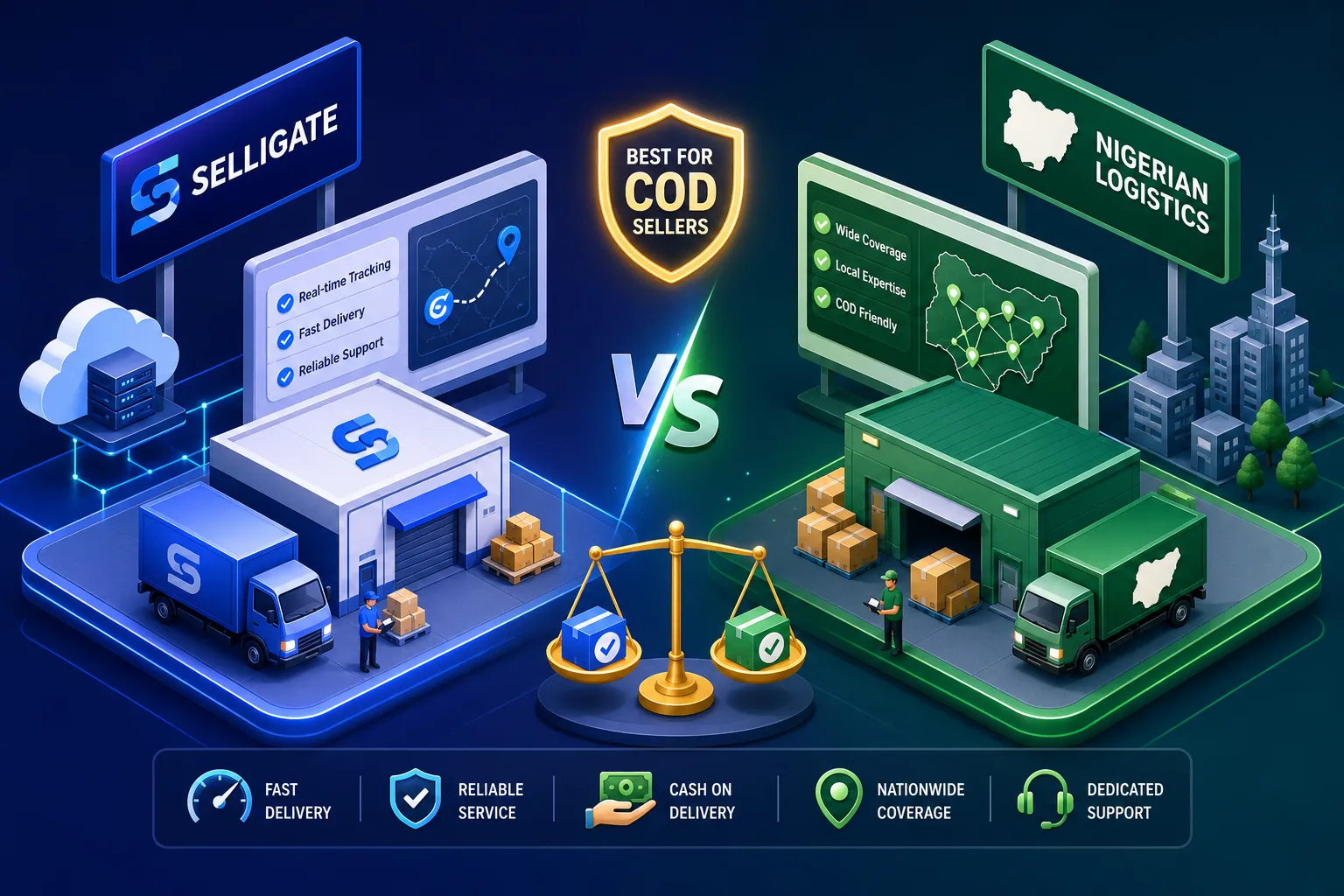
This article puts Selligate E-commerce Fulfillments directly alongside the most commonly used Nigerian logistics providers, GIG Logistics, Sendbox, and Kwik, and compares them on five criteria that directly affect your revenue: COD handling, payment remittance, same-day delivery, warehousing, and return management. By the end, you will know which one was built for your business and which ones were not.
The core difference: logistics companies vs. fulfilment partners
Most Nigerian logistics providers are built around one core function: picking up a parcel and moving it. They are optimised for transit, not for merchant success. Their business model works whether your order gets accepted or rejected, many providers charge for the delivery attempt regardless of outcome, according to their standard pricing terms. That is not alignment; that is a conflict of interest dressed up as a service.
A fulfilment partner operates on a fundamentally different model. It stores your inventory close to your customers, processes orders through a system, collects payment on delivery, and remits it directly to you. The entire structure is tied to successful delivery. No delivery, no fee. Selligate was built by e-commerce merchants who experienced COD rejections firsthand while running their own online store, Injina Store. It was not designed as a repackaged courier service. It was designed from scratch around the merchant’s cash flow.
That origin matters. When a platform is built by sellers who faced the same problems you are facing, the product decisions look very different from one built by logistics engineers optimising van routes.
Selligate vs other logistics companies in Nigeria: COD handling and payment remittance
The standard remittance cycle across most Nigerian logistics providers runs anywhere from 7 to 15 working days after delivery, a range consistent with widely reported industry norms for cash-on-delivery remittance. For a seller running paid Facebook or Instagram ads, that gap is damaging. You are funding ad spend today for revenue that will not reach your account for two weeks, assuming the delivery even succeeded. That is not cash flow; that is a credit arrangement you never agreed to. (For carrier examples of payout timing see how soon you can receive your COD amount in your bank account.)
Selligate automatically credits your merchant wallet the moment an order is delivered, and payment is collected from the customer. There is no batch cycle, no reconciliation call, no waiting on someone else’s schedule. You request a withdrawal, and it reflects in your bank account. Based on publicly available information, Sendbox and Kwik do not appear to offer automatic real-time wallet crediting as a standard feature of their service. For a seller moving volume daily, the difference in accessible cash across a single month is material.
Same-day delivery and nationwide reach
Same-day delivery is not a promise you can make from a single warehouse in Lagos to a customer in Enugu. It only works if your product is already stored in the city where the customer lives. That is the infrastructure gap that most providers in the e‑commerce logistics space cannot fill, because their model is built around picking up from you and transiting to the buyer.
Selligate pre-positions your bulk inventory across 84 operational warehouses in 35 cities and 30 states. When an order comes in, the item is already in the customer’s city. Same-day delivery is not a marketing claim; it is a structural outcome of how the inventory is positioned.
The comparison across providers is instructive. Kwik offers same-city urgent delivery across Lagos, Abuja, Ibadan, Kano, Port Harcourt, and Kaduna, but it has no multi-city pre-positioning infrastructure. Orders outside these six cities typically take two to five days and face higher failure rates. GIG Logistics has broad national coverage, but it operates as a transit courier rather than a warehousing network, so delivery timelines depend on transit distance, not stock proximity. Sendbox provides multi-carrier routing, which is useful, but timelines are subject to the third-party couriers in its network. For smaller cities such as Umuahia, Abakaliki, Ado Ekiti, and Ughelli, Selligate lists confirmed coverage through its pre-positioned warehouse network; the other providers compared here focus primarily on major urban hubs and do not typically offer same-day service in these locations.
Warehousing and inventory management, Selligate vs other logistics companies in Nigeria
Most Nigerian online sellers ship from home or from a single Lagos location. Every order going to Kano, Aba, or Asaba is a two-to-five-day transit order at best. Customers cancel during that wait. Deliveries fail on arrival. Returns travel back the same distance. The economics of COD selling across Nigerian states without pre-positioned stock are difficult, and sellers absorb those costs without always tracking where they go.
Based on available service information, GIG Logistics and Kwik are primarily transit-focused, with storage and inventory management remaining the merchant’s responsibility. Sendbox offers pickup and delivery service as well as international shipments, which is a useful option for some e-commerce sellers, but warehousing and inventory management are not their core services.
Selligate’s model includes complimentary warehousing at all 84 locations as part of the merchant onboarding process. You ship stock in bulk to the relevant city warehouses, and Selligate manages storage from there. This reduces your per-order delivery cost, improves delivery success rates, and eliminates the transit window that causes most COD rejections in the first place. When a product is already in Kano, there is no transit period for the customer to change their mind.
Return management and order rejection handling
COD return rates for Nigerian e-commerce sellers using unstructured logistics arrangements range from 20 to 40%, according to industry benchmarks for the Nigerian market. The cost of a failed delivery goes beyond the delivery fee, it includes restocking, re-shipping, and the time spent managing what came back. Most sellers track their order numbers but not the true cost of their rejection rate. High failure rates can erode a significant portion of operating margin, particularly for sellers running paid acquisition at scale. For broader discussion of rising COD order failure rates in comparable markets, see industry reporting on the subject.
Many logistics providers treat a failed delivery as a completed job. They return the item to the sender and close the ticket. What happens to your inventory after that is entirely your concern. If you are based in Lagos and the customer was in Port Harcourt, that return journey adds cost before the item is even available to sell again.
Because Selligate operates as a fulfilment partner rather than a courier, return and rejection management is built into the service. Returned items go back into the nearest city warehouse, not back to your home or office in Lagos. Replacement orders can be processed from the same location without requiring a new bulk shipment. This reduces the total cost of each failed order and keeps your inventory in circulation rather than stuck in transit.
The verdict: which partner was actually built for COD sellers?
Here is a direct summary of where each provider stands when you compare Selligate with other logistics companies in Nigeria, based on the criteria that matter most to COD sellers. GIG Logistics is reliable for general parcel movement and has improved its COD offering for CLASS merchants but still lacks same day delivery and instant settlement. Kwik is strong in urgent same-city deliveries but lacks nationwide pre-positioning infrastructure. Sendbox provides solid multi-carrier access but does not include automatic real-time remittance or built-in return management as standard.
If you are running a straightforward courier requirement, send a parcel, collect on delivery, wait for settlement, any of these options can serve you at some level. But if you are selling physical products via paid ads, managing COD payments at scale, and trying to deliver same-day across multiple Nigerian cities while keeping your cash flow intact, none of them were designed for that job.
Among the services compared here, Selligate is the one designed end-to-end for e-commerce merchants. The pay-only-on-delivery model, automatic wallet crediting, pre-positioned warehousing across 35 cities, same-day deliveries, automatic inventory reconciliations, and built-in return management all reflect a single design principle: a platform built by sellers who understand the problem from the inside. If you are weighing up cash-on-delivery logistics options in Nigeria and want a partner whose model is aligned with your success rather than your shipment volume, that distinction is worth taking seriously.
If you are ready to stop stitching your fulfillment together with couriers and dispatch riders, the next step is straightforward. Register as a Selligate merchant, ship your inventory into the network, and let the platform handle delivery, payment collection, and remittance. Your cash flow should not depend on a courier’s reconciliation schedule.