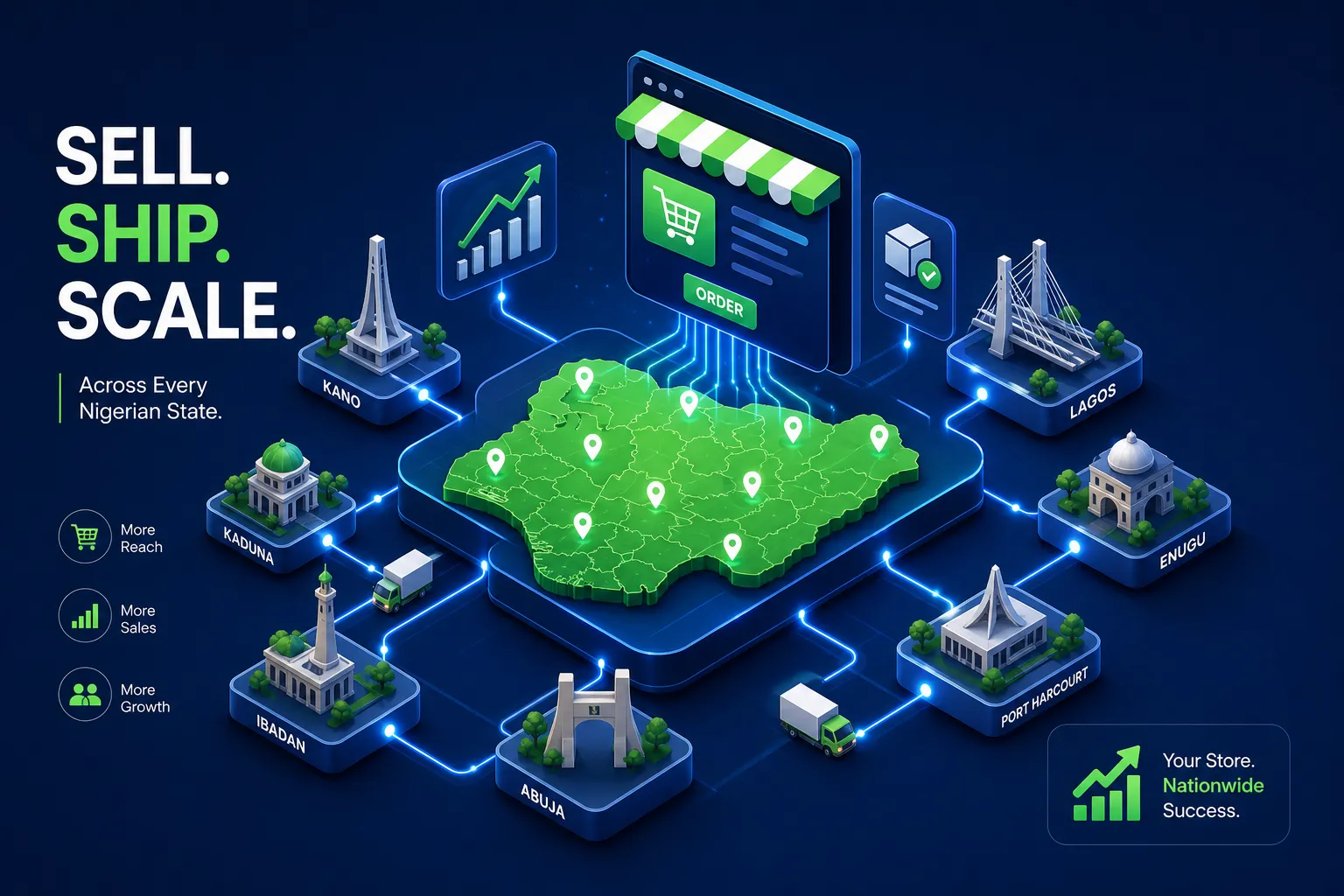
How can you grow your e-commerce business to all states in Nigeria when most sellers are still stuck serving Lagos and one or two other cities? Nigeria had an estimated 76.7 million online shoppers as of 2025, with roughly 82% of them browsing and buying on mobile. Yet most Nigerian e-commerce sellers fulfil orders only from Lagos, or at best Lagos and one other city. That gap between where shoppers are and where sellers operate remains one of the biggest untapped opportunities in Nigerian commerce today.
The mobile commerce market hit USD 7.66 billion in 2025 and is projected to exceed USD 15.9 billion by 2031. Secondary cities such as Kano, Ibadan, and Enugu are seeing e-commerce growth rates in the range of 15% annually, consistent with the wider northern and south-western regional CAGR figures cited in recent market research. Buyers in those markets want fast delivery and secure payment, and the sellers who figure out how to serve them reliably will own those markets for years. Those who wait will be playing catch-up.
Scaling nationwide sounds complex, but it follows a clear process: solve logistics first, build your payment stack, and align your marketing with your fulfillment reach. This guide walks through each step so you can move from planning to execution without getting stuck in the details.
Understand the Nationwide E-commerce Opportunity Before You Plan
How large Nigeria’s online market actually is right now
Nigeria’s internet penetration sits at roughly 46%. The government’s National Broadband Plan targeted 70% coverage by 2025, a goal that remains partially unmet, which means tens of millions of Nigerians are still coming online for the first time, and a good proportion of them will shop. Lagos, Abuja, and Port Harcourt are the established hubs with the highest concentration of current buyers, but the real headroom for first movers is in secondary cities. Kano, Ibadan, and Enugu are all growing fast, and sellers already positioned there face far less competition than those still fighting for attention in Lagos. Recent industry analysis supports these trends and helps explain the headroom available to first movers in secondary cities: Nigeria e-commerce market research.
Where buyer behaviour differs by region
The mobile-first transaction data tells you something important: your entire customer experience, from product discovery to checkout, needs to work flawlessly on a smartphone. Social commerce through WhatsApp and Instagram is not merely a trend in Nigeria, it is the dominant channel for product discovery and sales conversion, particularly among buyers in urban and peri-urban markets nationwide. Nigerian shoppers share the same core priorities wherever they are: fast delivery, secure payment, and clear return policies. Northern states still have lower digital penetration compared to the south, but female agent programmes and improving mobile infrastructure are closing that gap quickly. These are buyers coming online ready to purchase.
How to Grow Your E-commerce Business to All States in Nigeria: Start with Logistics
Why courier-only models break down at scale
Major domestic couriers such as GIGL operate extensive nationwide networks and can deliver to all 36 states. The problem is structural: they ship from fixed pickup hubs, and waybill delivery timelines stretch to three to five days when goods originate in Lagos. For cash-on-delivery orders, that delay is costly. The longer a parcel sits in transit, the more time a customer has to change their mind, move house, or simply become unreachable, and COD rejection risk compounds with every day the order spends on the road. A courier can move a parcel; it cannot fix that fundamental problem.
Last-mile delivery and the case for inventory pre-positioning
Last-mile delivery, the final leg from a local hub to the customer’s door, is where most Nigerian e-commerce businesses either win or lose at scale. The logic is straightforward: put your stock inside the destination state before the order arrives, not after. When a customer in Kano places an order and a local hub already holds that item, fulfilment can happen within the same day rather than waiting for a cross-country shipment from Lagos. That speed collapses rejection risk and builds the kind of delivery reputation that generates repeat purchases.
The challenge is that building your own regional warehouses is genuinely expensive. A basic 1,000-square-metre warehouse in Lagos costs approximately ₦150 million in construction alone, before land acquisition and permits (based on current construction cost estimates of roughly ₦150,000 per square metre). Multiply that across Abuja, Port Harcourt, Kano, and Ibadan and the capital requirement becomes unrealistic for most sellers. For reference on typical build costs and what goes into warehouse construction, see this guide to the cost to build a warehouse.
The smarter route is plugging into a fulfilment network that already has the infrastructure live. Selligate E-commerce Fulfillments operates 40+ distribution points across Nigeria, covering multiple states so sellers can pre-position stock without building or leasing their own warehouses. A seller ships stock in bulk to those locations, assigns orders through the Selligate app, and the customer receives fast local delivery while Selligate collects payment on the seller’s behalf. Once a delivery is confirmed, funds are credited automatically to the merchant’s wallet with bank withdrawal available. No warehouse lease, no staffing overhead, no logistics management complexity. If you need context on interstate delivery options and third-party logistics that serve multiple states, this write-up on interstate delivery services in Nigeria is a practical reference.
Evaluating any logistics partner against real criteria
Before committing to a fulfilment partner, work through four key questions. First, how many states do their distribution points actually cover, and is stock pre-positioned locally or shipped in from a central hub? Second, do they handle COD collection and direct remittance to your account, or do they only move parcels and leave payment collection entirely to you? Third, is there real-time order tracking so you can see delivered, pending, and rejected orders at a glance? Fourth, what is their average last-mile delivery time per state, and how does that compare across the regions you intend to enter? The answers separate a genuine fulfilment partner from a basic courier service, and the difference in your COD rejection rate will reflect that distinction clearly.
Set Up Payment Collection That Works Across Every State
Why cash on delivery still dominates and what that costs you
COD accounts for a large share of Nigerian e-commerce orders, industry estimates place it at around 65% of transactions, because consumer trust in prepaid online payments remains genuinely low in many markets. Selling nationwide means accepting this reality and building logistics infrastructure capable of collecting payment at the door across multiple states. The risk is rejection: a customer who refuses delivery costs you shipping fees, return logistics, and the time value of tied-up inventory. Pre-positioned fulfilment is the structural fix. Clear product descriptions, phone number verification before dispatch, and confirmation calls before delivery runs are the operational fixes that reduce rejection rates on top of that.
Digital payment gateways worth integrating
Alongside your COD process, a proper payment stack handles buyers who prefer to pay upfront. Paystack charges 1.5% plus ₦100 per local card transaction, capped at ₦2,000, with T+1 settlement (funds arrive the next business day) for verified Nigerian businesses. Flutterwave charges 1.4% plus ₦50 on local card transactions, with settlement typically within 24 to 48 hours, verify current terms on their respective pricing pages as rates are subject to change. Interswitch is the CBN-licensed option for merchants who want bank-grade payment infrastructure. All three support merchants across every state. For social commerce sellers taking orders through Instagram DMs or WhatsApp, a payment link from Paystack or Flutterwave provides a clean checkout experience that also reduces COD friction for buyers willing to pay upfront.
Build a Region-Specific Marketing Strategy
Geo-targeting on Facebook and Instagram by state
Nigeria’s 36 states are not one homogeneous market. Price sensitivity, product preferences, and buying triggers vary between Lagos, Kano, and Enugu. Running a single national ad campaign treats them all the same and wastes budget. The practical approach is to use Facebook Ads Manager’s location targeting to create separate ad sets for each region, start with small test budgets in new states, and track cost per purchase by location. States where the numbers look good get more budget. States where the economics are weak get their creative or price point adjusted before you scale. Critically, only advertise in a state once your inventory is already pre-positioned there. Marketing without fulfillment reach generates orders you cannot fill well.
Social commerce tactics that convert in new markets
WhatsApp broadcast lists and Instagram Stories are among the highest-converting channels for Nigerian social commerce sellers. When entering a new state, two things reduce buyer hesitation faster than almost anything else: testimonials from customers in that specific region and local delivery proof, such as tracking screenshots or delivery photos. When a potential buyer in Ibadan sees that you delivered to another customer in Ibadan yesterday, the trust barrier drops significantly. Use region-relevant language and references in your ad copy. A Lagos-coded ad running in Kano is visible but not relatable, and relatability is what converts scrollers into buyers.
Your 90-Day Roadmap to Grow Your E-commerce Business Across All Nigerian States
Phase 1 (days 1, 30): Lay the logistics and compliance foundation
Select a fulfillment partner whose distribution points cover the states you plan to enter first, and confirm whether stock is held locally or shipped from a central hub. Ship an initial bulk inventory consignment to two or three hubs outside your current base.
On the payments side, set up a Paystack or Flutterwave account for digital payment collection alongside your COD process. Aim to have stock pre-positioned in at least two new states and a compliant payment stack running by the end of this phase, though exact timelines will depend on your inventory availability and how quickly your chosen fulfilment partner can onboard you.
Phase 2 (days 31, 60): Test marketing in two new states
Launch low-budget Facebook ad sets targeting your chosen expansion states. Keep the budgets modest, track cost-per-purchase carefully, and monitor COD rejection rates by state. The data from this phase tells you whether the problem is your product positioning, your price point, your ad creative, or the market itself. Do not scale spend until you understand which variable is working and which is not. This phase is about gathering real information, not hitting revenue targets.
Phase 3 (days 61, 90): Optimise and expand based on real data
Increase inventory at hubs with strong sell-through and low rejection rates. Pause or restructure campaigns in states where the economics do not yet work. Begin onboarding the next batch of distribution locations based on your phase two data. By day 90, you should have a clear picture of which states are profitable, what your nationwide COD rejection rate looks like, and where to double down next quarter. Every decision in this phase is backed by actual numbers from your own business, provided on your dashboard if you use a fulfillment service like Selligate, not assumptions.
The Path Forward: Growing Your E-commerce Business Nationwide
Scaling nationwide is not about doing more of everything at once. It is about solving logistics first, then expanding marketing in sync with your fulfilment reach. Sellers who try to grow before sorting their logistics infrastructure hit the same wall: high rejection rates, delayed payments, and returns that erode profit until the expansion becomes unsustainable.
Those who get it right pre-position inventory, use fulfilment infrastructure that handles COD collection and remittance automatically, and expand marketing only into states where their operations can actually deliver. That sequence matters, and getting it right makes nationwide expansion a structured, repeatable process rather than a chaotic stretch that breaks the business.
Start by auditing your current logistics setup against the criteria in this guide. If the gaps are significant, consider what a dedicated fulfilment partner with a pre-built nationwide network, distribution points already live across 40+ locations, fast local delivery, and automatic payment remittance, can do for your expansion timeline. For broader market context and reporting on how e-commerce growth is driving demand for storage and logistics, see reporting on warehouse space in high demand as e-commerce booms. If you have been asking how to grow your e-commerce business to all states in Nigeria, the infrastructure to do it already exists. The only variable is whether you deploy it before your competitors do.
Frequently Asked Questions
How can I grow my e-commerce business to all states in Nigeria without building my own warehouses?
Partner with a fulfilment network that already has distribution points pre-positioned across multiple states. Services like Selligate E-commerce Fulfillments allow you to ship bulk stock to existing hubs and fulfil orders locally, eliminating the capital cost of building or leasing your own regional warehouses.
What is the biggest challenge when expanding e-commerce operations nationwide in Nigeria?
Logistics and last-mile delivery. Courier-only models that ship from a single Lagos hub create three-to-five-day delivery windows, which significantly increase COD rejection rates. Pre-positioning inventory inside destination states before orders arrive is the most effective structural solution.
Which payment methods should I offer to reach customers in all Nigerian states?
Cash on delivery remains dominant and should be supported as your primary option. Layer in a digital payment gateway, Paystack, Flutterwave, or Interswitch, to capture buyers who prefer to pay upfront. This combination covers the broadest range of buyers across all 36 states.
Do I need special licences to sell e-commerce goods across all Nigerian states?
At minimum, you need CAC registration, FIRS registration for VAT purposes, and compliance with the Nigeria Data Protection Act. NAFDAC licensing applies if you sell food, health products, or pharmaceuticals. State-level obligations apply wherever you physically operate, another reason many sellers choose third-party fulfilment rather than owning warehouses in multiple states.